


Table of Contents:
- Introduction
- Understanding SEO in Modern Digital Marketing
- What Is GEO and Why Is It Important?
- The Evolution of Search Behavior
- Can SEO and GEO Strategies Work Together for Better Results?
- Key Differences Between SEO and GEO
- How SEO Builds the Foundation for GEO
- How GEO Enhances Traditional SEO Performance
- Why Businesses Must Combine SEO and GEO
- The Role of AI in Search Visibility
- Best Practices for Combining SEO and GEO
- Common Mistakes Businesses Should Avoid
- Real-World Benefits of SEO and GEO Integration
- Future Trends in SEO and GEO
- Frequently Asked Questions
- Final Thoughts
- Strong Call to Action
Introduction
Digital marketing has changed significantly over the last 10 years. In the past, businesses mainly relied on traditional search engine optimization (SEO) to boost their rankings and attract visitors. SEO is still important, but now artificial intelligence and new search technologies are changing how people find information online. Companies need to optimize for both traditional search engines and AI-powered search tools. That’s where GEO strategies become important.
With more people using AI-driven tools like Google AI Overviews, ChatGPT, Gemini, Bing Copilot, and Perplexity, many businesses are now wondering: Can SEO and GEO strategies work together for better results?
The answer is yes. In fact, using both strategies together can be one of the best ways to boost your digital visibility in today’s competitive online world.
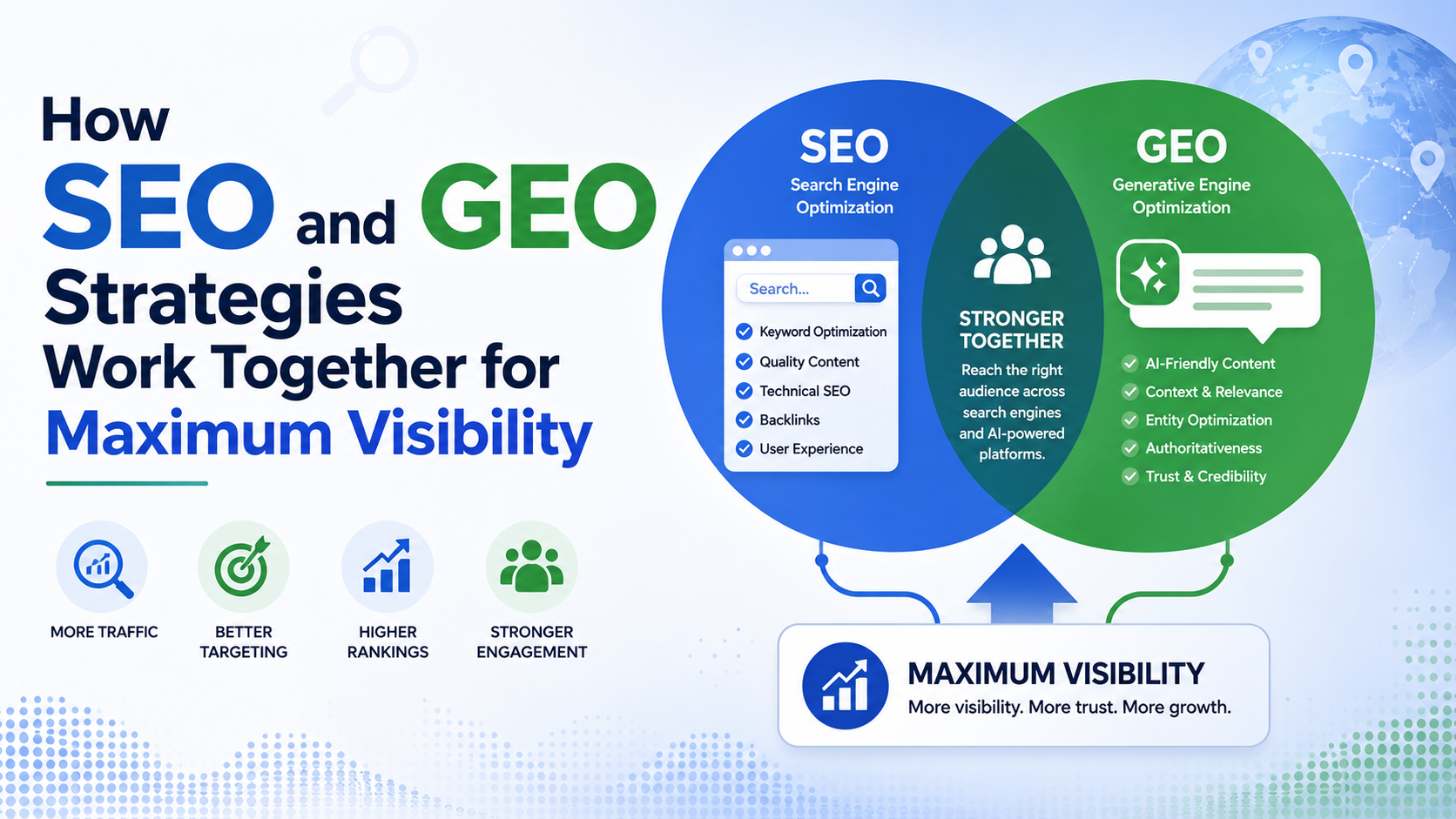
SEO and GEO are not competing methods. They actually work well together. SEO helps websites rank in traditional search engine results pages (SERPs), while GEO helps AI systems understand, summarize, and recommend your content.
When used together, they form a complete strategy that brings in organic traffic, builds authority, and boosts conversions.
This guide will show how SEO and GEO work together, why both matter, and how businesses can use them to stay ahead of the competition.
Understanding SEO in Modern Digital Marketing
Search Engine Optimization (SEO) is the practice of improving a website’s visibility in search engines. Its primary purpose is to increase organic traffic by helping web pages rank higher for relevant search queries.
SEO includes several core areas:
- On-page SEO
- Technical SEO
- Off-page SEO
- Content optimization
- Keyword research
- Link building
- User experience improvements
Search engines like Google use algorithms to determine which pages provide the most relevant and valuable information for users. SEO helps websites align with these ranking factors.
Key Components of SEO
1. Keyword Optimization
Keywords remain a fundamental part of SEO. Businesses research the phrases users search for and optimize content around those terms.
For example, the keyword:
“Can SEO and GEO strategies work together for better results?”
helps target users interested in modern digital marketing strategies.
However, modern SEO no longer focuses solely on keyword repetition.
Search engines now prioritize:
- Relevance
- Context
- Search intent
- Semantic meaning
This means content must genuinely answer user questions.
2. Technical SEO
Technical SEO ensures search engines can crawl and index websites efficiently.
Important technical factors include:
- Website speed
- Mobile responsiveness
- Secure HTTPS connections
- XML sitemaps
- Clean URL structures
- Structured data markup
Without strong technical SEO, even excellent content may struggle to rank.
3. Content Quality
High-quality content remains one of the most important ranking factors.
Search engines favor content that:
- Answers user questions
- Demonstrates expertise
- Provides accurate information
- Offers unique value
- It is easy to read
Comprehensive content often performs better because it better satisfies user intent.
4. Link Building
Backlinks from trusted websites help establish authority.
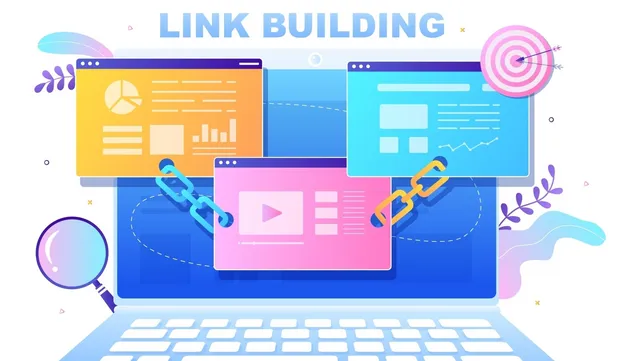
When credible websites link to your content, search engines view your website as more trustworthy and authoritative.
What Is GEO and Why Is It Important?
GEO stands for Generative Engine Optimization. It refers to optimizing content for AI-driven search experiences that deliver direct answers to users rather than simply displaying lists of links.
Examples include:
- Google AI-generated summaries
- ChatGPT responses
- Gemini AI results
- Bing Copilot answers
- AI-powered voice assistants
GEO focuses on helping AI systems:
- Understand content clearly
- Identify trustworthy sources
- Extract useful information
- Present content accurately
As AI search grows, GEO becomes increasingly important for online visibility.
The Evolution of Search Behavior
Search behavior has changed dramatically in recent years.
Previously, users searched using short phrases like:
- “best SEO company”
- “digital marketing tips”
- “local SEO agency”
Today, users increasingly ask conversational questions such as:
- “Can SEO and GEO strategies work together for better results?”
- “How do AI search engines rank content?”
- “What is the future of SEO with AI?”
AI-powered systems respond by generating summarized answers directly within the search experience.
This shift means businesses must optimize content not only for search engines but also for AI understanding.
Can SEO and GEO Strategies Work Together for Better Results?
Absolutely. In fact, combining SEO and GEO is becoming essential for long-term digital marketing success.
SEO provides the foundational structure that helps websites rank, while GEO improves the accessibility and usability of content for AI-driven search systems.
Together, these strategies help businesses:
- Increase organic visibility
- Improve AI discoverability
- Build topical authority
- Reach users across multiple platforms.
- Future-proof marketing strategies
Businesses that integrate both approaches gain a significant competitive advantage.
Key Differences Between SEO and GEO
Although SEO and GEO overlap, they have distinct goals.
SEO GEO
Optimizes for traditional search rankings Optimizes for AI-generated answers
Focuses on search engine algorithms Focuses on AI interpretation
Uses keywords heavily Uses semantic clarity heavily
Relies on backlinks Relies on authority and context
Improves SERP visibility Improves AI recommendation visibility
Targets organic clicks Targets AI-driven exposure
Understanding these differences helps businesses create balanced optimization strategies.
How SEO Builds the Foundation for GEO?
SEO creates the technical and content infrastructure necessary for GEO success.
Without proper SEO, GEO efforts become far less effective.
1. Technical SEO Improves AI Accessibility
AI systems still rely on crawlers and indexing systems similar to traditional search engines.
Websites with:
- Fast performance
- Proper indexing
- Mobile optimization
- Secure connections
- Clean navigation
are easier for AI systems to analyze and understand.
Poor technical SEO can prevent AI tools from accessing content effectively.
2. Structured Content Helps AI Understand Information
SEO best practices encourage:
- Clear headings
- Organized content
- Bullet points
- Logical formatting
These same practices improve AI comprehension.
AI systems prefer content that is:
- Well-structured
- Easy to summarize
- Clearly organized
3. Authority Signals Strengthen GEO Performance
SEO helps establish authority through:
- Backlinks
- Brand mentions
- High-quality content
- Positive user engagement
AI systems are more likely to trust and reference authoritative websites.
4. Semantic SEO Supports GEO
Modern SEO emphasizes semantic relationships between topics.
This helps AI systems understand:
- Context
- Related concepts
- User intent
- Topic depth
Semantic optimization is essential for both SEO and GEO success.
How GEO Enhances Traditional SEO Performance?
GEO can also strengthen traditional SEO efforts.
1. Better User Experience
GEO encourages content that:
- Answers questions directly
- Uses conversational language
- Improves readability
These qualities improve user satisfaction and engagement metrics, thereby positively influencing SEO rankings.
2. Expanded Visibility
AI-generated search experiences create additional exposure opportunities.

When AI systems reference your content, users may:
- Visit your website
- Share your content
- Link to your pages
This can strengthen overall SEO performance.
3. Improved Brand Recognition
Appearing in AI-generated answers increases brand visibility and authority.
Users often associate referenced brands with expertise and trustworthiness.
Why Businesses Must Combine SEO and GEO?
The digital world is changing quickly. Search habits, technology, and customer expectations are all shifting simultaneously. Businesses that used to rely solely on traditional SEO now face a new reality in which artificial intelligence shapes how people find information. On the other hand, companies that focus only on new AI strategies and ignore basic SEO risk losing the organic traffic that still brings in many online conversions.
That’s why businesses should use both SEO and GEO, rather than picking just one.
It’s no longer about whether SEO or GEO is important. The real question is whether businesses are ready to adapt to a world where both traditional search engines and AI-powered systems affect online visibility. Companies that don’t keep up may slowly lose their search presence, customer engagement, and competitive edge.
Using both SEO and GEO together gives businesses a more balanced, sustainable, and future-proof digital marketing strategy. This helps them stay visible across all types of modern search experiences.
The Search Landscape Is No Longer Traditional
For many years, search engine optimization revolved around ranking on Google’s search engine results pages (SERPs).
Businesses focused heavily on:
- Keywords
- Backlinks
- Metadata
- Technical SEO
- Blog content
- Page rankings
The primary goal was simple: appear on the first page of search results and attract clicks.
While these elements are still essential, the search environment has changed dramatically, as users no longer interact with search engines the same way they did a decade ago.
Today, users increasingly rely on:
- AI-generated answers
- Voice search assistants
- Conversational queries
- Smart devices
- Predictive search experiences
Instead of clicking through multiple websites to find answers, users now expect direct, immediate, and summarized responses. Platforms like Google AI Overviews, ChatGPT, Gemini, Perplexity, and Bing Copilot are transforming how information is delivered.
This evolution means businesses need optimization strategies that work across both traditional search engines and AI-powered systems.
That is where the combination of SEO and GEO becomes critical.
Traditional SEO Alone Is No Longer Enough
SEO remains one of the most important digital marketing strategies available.
Organic search traffic still delivers:
- High-intent visitors
- Long-term visibility
- Brand awareness
- Cost-effective lead generation
- Sustainable traffic growth
However, relying only on traditional SEO can limit visibility in modern AI-driven search environments.
Search engines are increasingly integrating generative AI directly into search results.
Instead of displaying only blue links, search engines now provide:
- AI-generated summaries
- Conversational responses
- Quick answer boxes
- Contextual recommendations
In these environments, users may receive answers without ever clicking traditional search results.
This creates a major challenge for businesses that optimize only for traditional rankings.
Even highly ranked websites on Google may see reduced click-through rates if AI systems summarize information directly within the search results.
Without GEO strategies, businesses risk:
- Reduced visibility
- Lower traffic potential
- Decreased brand recognition
- Limited exposure in AI-powered search experiences
Modern visibility requires more than ranking pages. It requires becoming a trusted source that AI systems can interpret, summarize, and recommend confidently.
GEO Helps Businesses Stay Visible in AI-Driven Search
Generative Engine Optimization (GEO) focuses on improving how AI systems understand and use content.
Unlike traditional SEO, GEO emphasizes:
- Context
- Semantic meaning
- topical authority
- conversational relevance
- clarity
- trustworthiness
AI systems prioritize content that is:
- Well-structured
- Informative
- Reliable
- Easy to summarize
- Contextually complete
Businesses using GEO strategies improve their chances of appearing in:
- AI-generated summaries
- conversational search responses
- voice assistant answers
- AI recommendation systems
This visibility is becoming increasingly valuable as AI-powered search experiences continue to grow rapidly.
However, GEO alone is not enough.
Businesses that focus only on GEO while ignoring SEO may struggle with:
- Poor website indexing
- weak technical performance
- slow page speeds
- low organic rankings
- reduced search authority
This is why combining both strategies is essential.
The Role of AI in Search Visibility
Artificial intelligence is transforming how search engines deliver information.

AI systems analyze:
- User intent
- Context
- Relationships between topics
- Content quality
- Authority signals
Instead of simply matching keywords, AI attempts to provide the best possible answer.
This means businesses must focus on:
- Expertise
- Clarity
- Trustworthiness
- Relevance
Best Practices for Combining SEO and GEO
Businesses should integrate SEO and GEO into a unified strategy.
Create Comprehensive Content
Long-form content often performs well because it provides:
- Detailed explanations
- Contextual depth
- Multiple related topics
- Strong semantic relevance
Comprehensive content benefits both search engines and AI systems.
Optimize for Questions
Question-based content aligns well with conversational search behavior.
Use:
- FAQs
- Question headings
- Direct answers
This improves the likelihood of appearing in AI-generated summaries.
Use Natural Language
Modern search increasingly favors conversational language.
Content should sound natural and human rather than robotic or overly optimized.
Focus on Search Intent
Businesses should prioritize understanding what users truly want.
Different search intents include:
- Informational
- Transactional
- Navigational
- Commercial
Matching user intent improves both SEO and GEO performance.
Build Topical Authority
Publishing consistent content around related subjects strengthens authority.
For example, a digital marketing agency may cover:
- SEO
- GEO
- AI marketing
- Technical SEO
- Content marketing
- Search trends
This helps search engines and AI systems recognize expertise.
Implement Structured Data
Schema markup helps systems interpret content more effectively.
Useful schema types include:
- FAQ schema
- Article schema
- Organization schema
- Review schema
Structured data improves search visibility opportunities.
Common Mistakes Businesses Should Avoid
Ignoring AI Search Trends
Some companies still assume traditional SEO alone is enough.
This mindset can lead to declining visibility as AI search adoption increases.
Keyword Stuffing
Overusing keywords harms readability and user experience.
Modern optimization prioritizes natural language and semantic depth.
Publishing Thin Content
Short, low-quality content often performs poorly in both SEO and GEO.
Search systems increasingly prioritize helpful, authoritative information.
Neglecting Technical SEO
Slow websites, poor mobile design, and indexing issues hurt visibility.
Technical optimization remains essential.
Real-World Benefits of SEO and GEO Integration
Businesses combining SEO and GEO often experience:
- Increased organic traffic
- Higher engagement rates
- Greater authority
- Better lead generation
- Enhanced customer trust
- Improved brand visibility
- Stronger competitive positioning
Integrated strategies create broader digital exposure.
Future Trends in SEO and GEO
The future of search will likely become even more AI-driven.
AI Summaries Will Expand
AI-generated summaries will become increasingly common across search platforms.
Businesses must optimize content for extraction and summarization.
Voice Search Will Continue Growing
Voice assistants rely heavily on conversational content and direct answers.
This strengthens the importance of GEO strategies.
Trust Signals Will Become More Important
Authority, credibility, and expertise will continue to gain importance.
Businesses must establish genuine trust online.
Semantic Optimization Will Dominate
Search systems increasingly understand relationships between ideas rather than isolated keywords.
Topical authority and contextual relevance will become critical.
5 Frequently Asked Questions About SEO and GEO

1. Can SEO and GEO strategies work together for better results?
Yes. SEO and GEO complement each other by improving visibility in both traditional search engines and AI-powered search experiences. SEO helps websites rank, while GEO helps AI systems understand and recommend content effectively.
2. Is GEO replacing SEO?
No. GEO is not replacing SEO. Instead, GEO expands optimization efforts to include AI-driven search platforms. Businesses still need traditional SEO for rankings and organic traffic growth.
3. Why is GEO becoming more important?
As AI-generated search experiences grow, businesses must ensure their content is visible within AI summaries and recommendations. GEO helps improve discoverability in these environments.
4. What type of content performs best for GEO?
Content that performs well for GEO is:
- Comprehensive
- Well-structured
- Conversational
- Accurate
- Authoritative
- Easy to understand
Long-form educational content often performs especially well.
5. How can businesses prepare for the future of search?
Businesses should:
- Combine SEO and GEO strategies.
- Invest in high-quality content.
- Improve technical SEO
- Build authority
- Optimize for conversational queries.
- Focus on user experience.
These steps help future-proof digital visibility.
Final Thoughts
The search world is changing faster than ever. Traditional SEO is still very important, but AI-driven search is changing how people find information online. Businesses that adapt early will gain major advantages.
So, can SEO and GEO strategies work together for better results?
Absolutely, yes.
SEO lays the groundwork for visibility in traditional search engines, while GEO makes sure your content is ready for AI-generated answers and conversational searches. Together, they offer a complete strategy to maximize your digital reach.
Companies that use both SEO and GEO effectively can:
- Reach broader audiences
- Build stronger authority
- Improve engagement
- Increase conversions
- Future-proof their online presence.
The future of search will favor businesses ready to grow and adapt to new technology.
Strong Call to Action
At Excell, we specialize in advanced SEO and GEO strategies designed to help businesses thrive in the modern digital landscape.
Whether your goal is to:
- Increase Google rankings
- Improve AI search visibility.
- Generate more qualified leads.
- Build long-term authority
- Stay ahead of competitors.
Our team has the expertise to help you succeed.

Don’t let your competitors take the lead in the future of search.
Work with Excell today and see how combining SEO and GEO can boost your online visibility, increase your traffic, and help your business grow.
Contact us today and Book your free discovery call to get done for your services.
Contact us:
EXCELL INDUSTRIES LLC
6420 Richmond Ave., Ste 470
Houston, TX, USA
Phone: +1 832-850-4292
Email: info@excellofficial.com