

Table of Contents:
- Introduction to Voice Search Local SEO
- What Is Voice Search and Why It Matters for Local SEO
- How Voice Search Is Changing Local Search Behavior
- The Role of AI and Natural Language Processing in Voice Search
- Voice Search vs Traditional Text Search: Key Differences
- Why Local Businesses Must Optimize for Voice Search
- How Search Engines Deliver Voice Search Results
- Optimizing Google Business Profile for Voice Search
- Voice Search, Local SEO, and Keyword Research Strategies
- How Conversational Keywords Impact Local Rankings
- Creating Voice-Search-Friendly Content
- Local Content Strategies That Win Voice Queries
- Structured Data and Schema Markup for Voice Search
- Mobile Optimization and Page Speed for Voice SEO
- Reviews, Ratings, and Trust Signals in Voice Search
- “Near Me” Searches and Hyperlocal Optimization
- Featured Snippets and Position Zero for Voice Search
- Voice Search and Local Link Building
- Tracking and Measuring Voice Search Performance
- Common Voice Search Local SEO Mistakes to Avoid
- 5 Key Questions About Voice Search Local SEO (Answered)
- The Future of Voice Search and Local SEO
- How Excell Helps Businesses Win Voice Search Rankings
- Final Thoughts and Strong Call to Action
1. Introduction to Voice Search Local SEO
- Google Business Profiles and other local listings
- Customer reviews and ratings
- Structured data and schema markup
- Well-optimized local content that clearly answers questions
2. What Is Voice Search and Why Does It Matter for Local SEO
Voice search is a search method that allows users to speak their queries aloud instead of typing them into a search engine. Using voice-enabled technologies such as smartphones, smart speakers (like Amazon Echo and Google Nest), smart TVs, wearables, and in-car assistants, users can instantly ask questions and receive spoken responses in real time. This hands-free, fast, and intuitive search experience has made voice search a daily habit for millions of people worldwide.

- Over 50% of voice searches have local intent.
A significant portion of voice queries are focused on finding nearby services, stores, restaurants, or professionals. These searches commonly include phrases such as “near me,” “closest,” “open now,” or “best in my area,” indicating strong local intent. - Voice searches often lead to immediate action.
Users who rely on voice search are typically closer to making a decision. Many voice searches result in actions such as calling a business, requesting directions, booking an appointment, or visiting a location within hours or even minutes. - Most voice search results come from top local listings, not traditional organic pages.
Unlike text-based searches, which display multiple results, voice assistants usually provide a single primary answer. This answer is often pulled from Google Business Profiles, local map listings, featured snippets, or highly trusted local sources. If your business isn’t optimized for these elements, it’s unlikely to be chosen.
3. How Voice Search Is Changing Local Search Behavior
- Queries are longer and more natural.
- Users ask questions, not keywords.
- Searches often include location-based intent.
- Results prioritize speed, accuracy, and relevance.
- Typed: “plumber Los Angeles.”
- Voice: “Who is the best emergency plumber near me right now?”
4. The Role of AI and Natural Language Processing in Voice Search
NLP helps search engines interpret:
- Context
- User intent
- Location relevance
- Conversational language
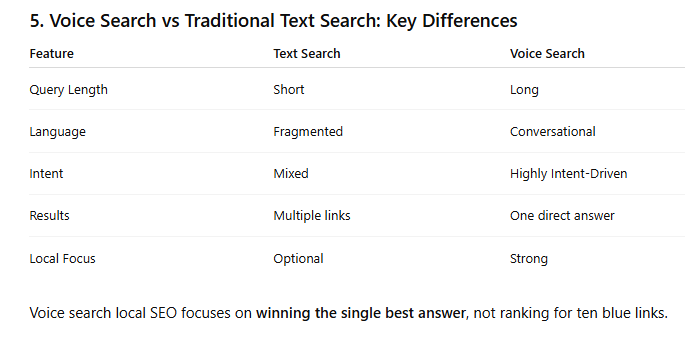
5. Voice Search vs Traditional Text Search: Key Differences
6. Why Local Businesses Must Optimize for Voice Search
These signals include:
- Consistent and accurate business information
- Strong Google Business Profile optimization
- High-quality customer reviews and ratings
- Clear service descriptions and categories
- Well-structured, authoritative local content
7. How Search Engines Deliver Voice Search Results
Google Business Profiles are one of the most important data sources for voice search, especially for local queries. When a user asks a question like “Where is the nearest urgent care clinic?” or “What time does the closest hardware store open?”, Google Assistant often relies on information directly from Google Business Profiles. Details such as business name, address, phone number, hours of operation, categories, services, and user reviews help search engines determine proximity and relevance. Incomplete or outdated profiles significantly reduce the chances of being chosen as a voice search result.
Featured snippets, often referred to as “Position Zero,” are another primary source for voice search answers. These are concise summaries displayed at the top of search results that directly answer a user’s question. Voice assistants frequently read these snippets aloud when responding to informational or service-related queries. Businesses that structure their content to clearly and concisely answer common questions are more likely to earn featured snippets, which dramatically increase visibility in local voice search SEO.
Search engines also rely on high-authority local websites when delivering voice search results. These include well-optimized business websites, local directories, news outlets, and industry-specific platforms that demonstrate strong credibility and relevance. Authority is measured through factors such as backlinks, content quality, user engagement, and topical expertise. If your website consistently provides accurate, locally relevant information, it becomes a trusted source for voice-based answers.
Structured data plays a crucial role in helping search engines understand the context of your content. Schema markup allows businesses to label key information such as services, locations, reviews, FAQs, and operating hours in a way that search engines can easily interpret. Voice assistants depend heavily on this structured data to quickly extract precise answers. Without it, even high-quality content may be overlooked.
8. Optimizing Google Business Profile for Voice Search
Your Google Business Profile (GBP) is the backbone of voice search local SEO.
- Ensure NAP consistency
- Choose accurate categories
- Add services and FAQs.
- Keep business hours updated.
- Use natural language in descriptions.
9. Voice Search, Local SEO, and Keyword Research Strategies
- Question-based keywords
- Long-tail conversational phrases
- “Near me” modifiers
- Service + location queries
- Google’s “People Also Ask”
- Search Console query reports
- Customer FAQs
- Chat-style AI tools for query simulation
10. How Conversational Keywords Impact Local Rankings
- “Where can I find…”
- “Who is the best…”
- “How much does it cost to…”
11. Creating Voice-Search-Friendly Content
- Answer questions clearly
- Use short, direct paragraphs.
- Include headings formatted as questions.
- Provide concise, authoritative responses.
12. Local Content Strategies That Win Voice Queries
- Local guides
- Service area pages
- FAQ sections
- Blog posts answering common local questions
13. Structured Data and Schema Markup for Voice Search
- LocalBusiness
- FAQ Page
- Review
- Service
- Organization
14. Mobile Optimization and Page Speed for Voice SEO
- Fast loading speed
- Mobile-first design
- Clean navigation
- Click-to-call functionality
15. Reviews, Ratings, and Trust Signals in Voice Search
- High ratings
- Frequent reviews
- Positive sentiment
- Consistent responses
16. “Near Me” Searches and Hyperlocal Optimization
“Near me” queries dominate voice search local SEO. Optimize by:

- Including neighborhood names
- Using landmarks
- Creating location-specific pages
- Updating service areas regularly
17. Featured Snippets and Position Zero for Voice Search
- Answer questions directly
- Use bullet points and lists.
- Keep answers under 50 words.
- Structure content clearly
18. Voice Search and Local Link Building
- Local directories
- Community partnerships
- Local news features
- Industry associations
19. Tracking and Measuring Voice Search Performance
- Question-based queries
- Local impressions
- Calls and direction requests
- GBP insights
- Featured snippet wins
20. Common Voice Search Local SEO Mistakes to Avoid
- Ignoring conversational keywords
- Outdated business listings
- No FAQ content
- Slow mobile pages
- Inconsistent NAP data
21. 5 Key Questions About Voice Search Local SEO (Answered)
2. Why is voice search important for local businesses?
3. How do I optimize my business for voice search?
4. Does voice search impact Google rankings?
5. Is voice search local SEO different from traditional SEO?
22. The Future of Voice Search and Local SEO
- Capture market share
- Build long-term authority
- Stay ahead of algorithm shifts.
23. How Excell Helps Businesses Win Voice Search Rankings
- Advanced keyword research
- Local content strategy
- Google Business Profile optimization
- Schema implementation
- Conversion-focused local SEO
24. Final Thoughts & Strong Call to Action
Voice search is no longer optional; it’s a competitive advantage. Businesses that adapt now will dominate local visibility while others struggle to catch up.

We help brands rank where it matters most at the exact moment customers ask for you.
6420 Richmond Ave., Ste 470
Houston, TX, USA
Phone: +1 832-850-4292
Email: info@excellofficial.com