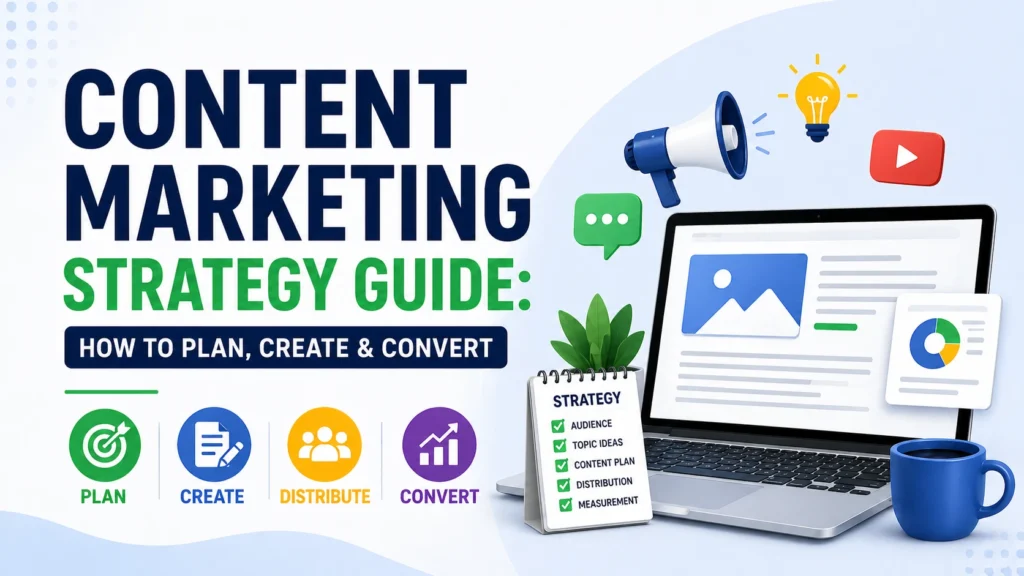
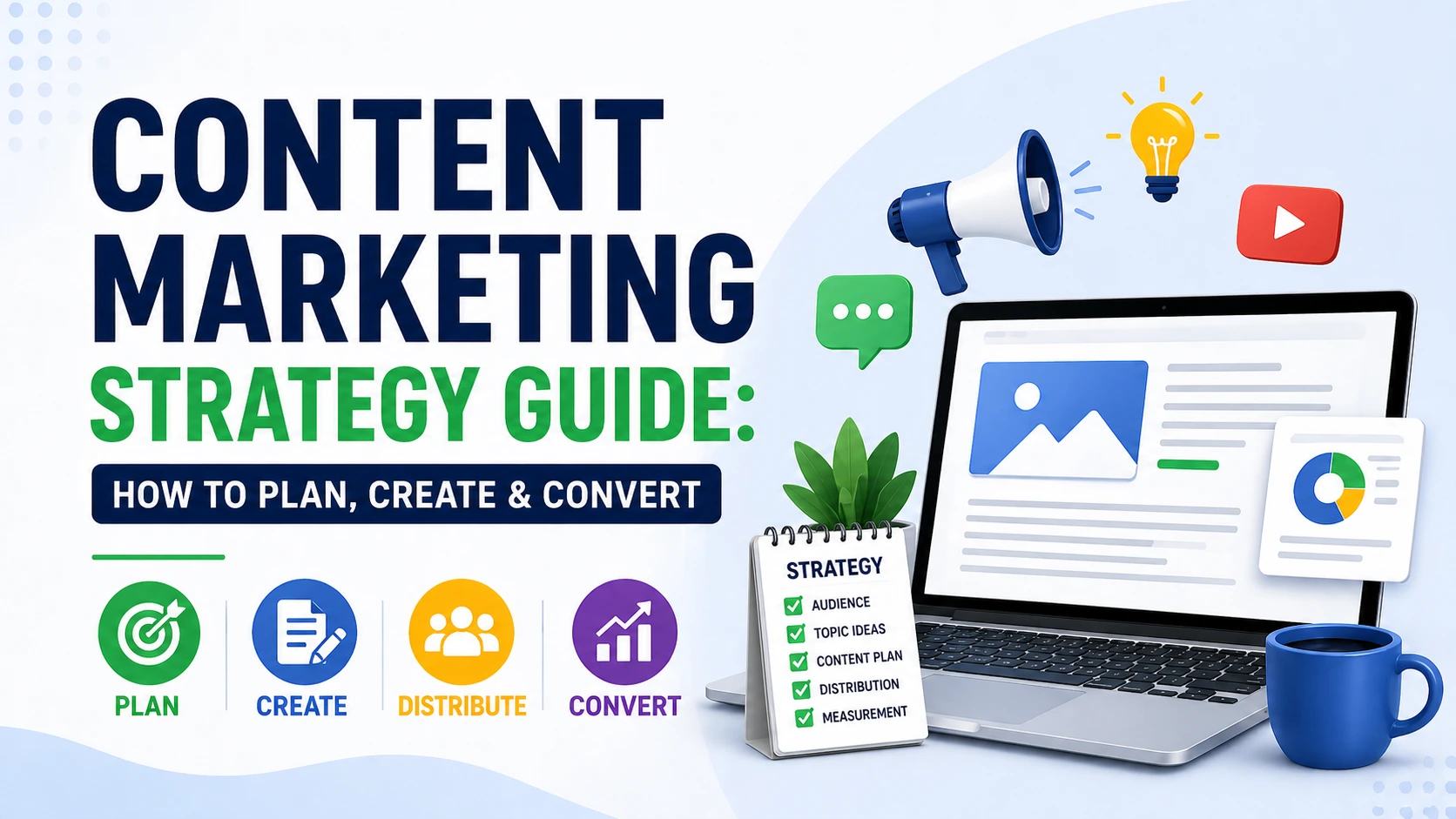
Content marketing strategy guide infographic with laptop, megaphone, checklist, and icons for planning, creating, distributing, and converting digital content

Content Marketing Strategy Guide: How to Plan, Create & Convert

Introduction

Today, just having a website or social media page is not enough. Brands compete for attention everywhere online. The businesses that stand out are the ones sharing useful, relevant, and well-planned content.

That’s why having a strong Content Marketing Strategy Guide is so important.
Content marketing is more than writing blog posts. It’s about creating a system that attracts, teaches, builds relationships, and turns your audience into customers. When done well, it’s one of the most affordable and scalable ways to grow.

A good Content Marketing Strategy Guide gives every piece of content a clear purpose. Rather than guessing, you use a proven plan that aligns with your business goals and your audience’s needs.

In this detailed guide, you’ll learn:
  • How to strategically plan your content
  • How to create content that drives real engagement
  • How to distribute content effectively
  • How to convert traffic into leads and customers
  • How to continuously optimize your strategy for growth
If you want your content to bring in steady revenue, this guide will show you how.

What is a Content Marketing Strategy Guide?

Content Marketing Strategy Guide is a detailed roadmap that outlines how your business will use content to achieve marketing and business objectives.

It goes beyond simply creating content. It defines:
  • Who your audience is
  • What content do they need?
  • When and where to deliver it
  • How to measure success
It’s the foundation for your digital marketing. Without a strategy, your content has no clear direction. With one, your content becomes a valuable asset for your business.

A strong Content Marketing Strategy Guide transforms content into:
  • A traffic generator
  • A lead generation engine
  • A conversion tool
  • A brand authority builder

Why Your Business Needs a Content Marketing Strategy?

Many businesses spend time and money on content but don’t see results. The main reason is a lack of strategy.
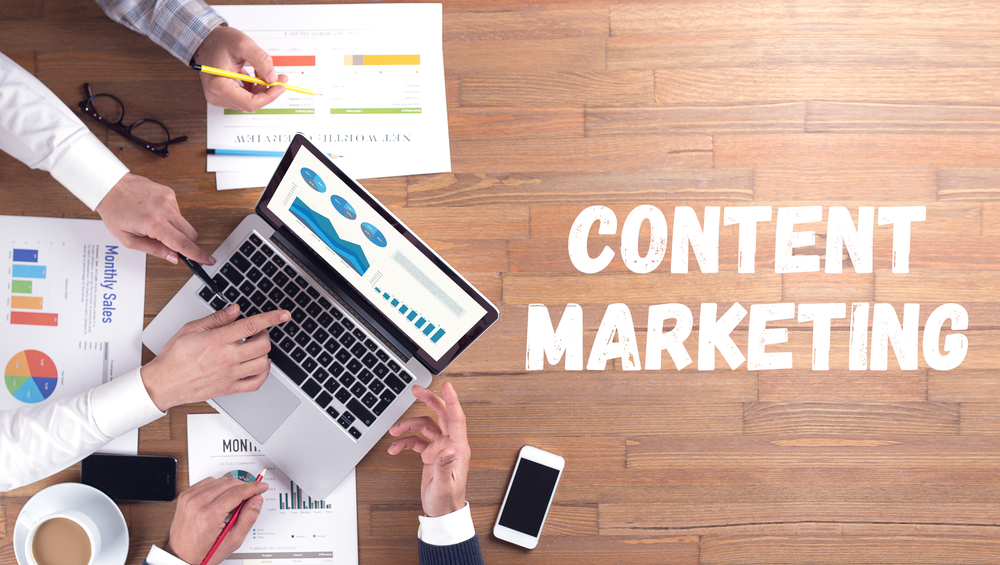
 

Content marketing strategy meeting with team analyzing data charts on laptop, reports, and smartphone on wooden desk for digital marketing planning
Here’s why a Content Marketing Strategy Guide is critical:

1. Eliminates Guesswork
Without a strategy, you’re just guessing what content might work. A clear plan takes away the guesswork and gives you direction.

2. Improves Efficiency
A clear process saves time and helps your team focus on what matters most.

3. Builds Long-Term Assets
Unlike paid ads, good content keeps bringing in traffic and leads long after you publish it.

4. Strengthens Brand Authority
Sharing high-quality content regularly helps your brand become known as an expert in your field.

5. Drives Sustainable Growth
A solid Content Marketing Strategy Guide gives you a repeatable way to attract and convert customers.

Key Components of a Winning Content Marketing Strategy Guide

1. Clear Goals and Objectives
Every successful strategy starts with clear goals. These could include:
  • Increasing website traffic
  • Generating qualified leads
  • Boosting conversion rates
  • Enhancing brand awareness

2. Audience Research and Personas
Understanding your audience is the backbone of your strategy. Go beyond demographics and explore:
  • Motivations
  • Challenges
  • Pain points
  • Buying behavior

3. Content Audit and Gap Analysis
Analyze your existing content to identify:
  • What is working
  • What needs improvement
  • What opportunities are you missing

4. Content Types and Formats
Different audiences prefer different formats. Use a mix of:
  • Blogs
  • Videos
  • Podcasts
  • Infographics
  • Case studies

5. SEO Strategy and Keyword Targeting
Search engine optimization is essential. Your Content Marketing Strategy Guide should focus on:
  • Primary keyword: Content Marketing Strategy Guide
  • Supporting keywords
  • Search intent

6. Content Calendar and Workflow
Consistency matters. A content calendar keeps you organized and on track.

7. Distribution Strategy
Content must be actively promoted to reach your audience.

8. Analytics and KPIs
Track performance metrics to measure success and improve results.

Step-by-Step: How to Plan Your Content Marketing Strategy

Step 1: Define Your Goals
Start by identifying what you want to achieve. Align these goals with your business objectives.

Step 2: Understand Your Audience
Create detailed buyer personas to guide your content creation.

Step 3: Conduct Keyword Research
 
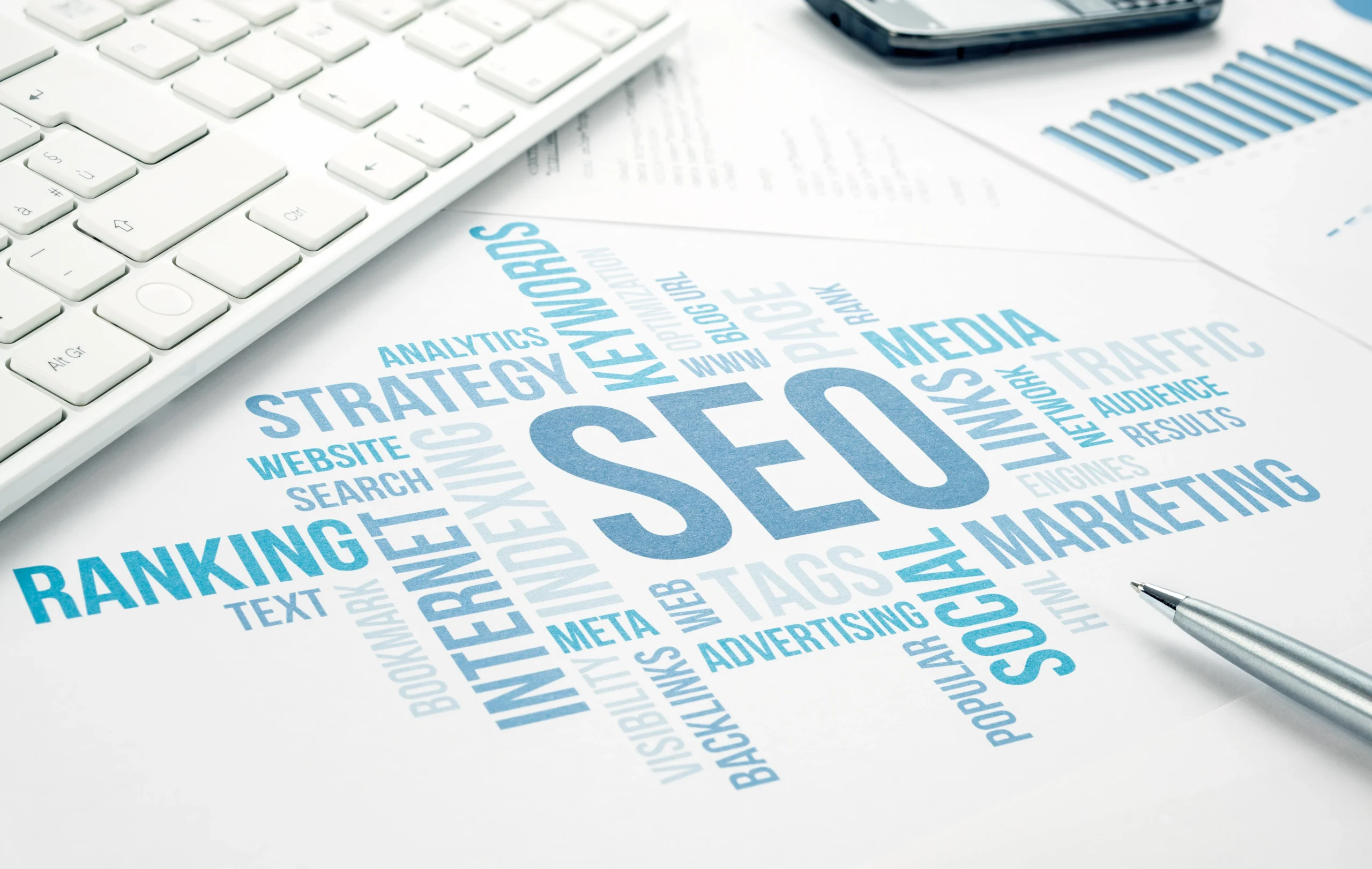
A keyword research strategy session showing the process of identifying high-ranking search terms, improving SEO performance, and driving organic growth through content analysis
Use SEO tools to identify high-value keywords. Focus on intent-based keywords that match your audience’s needs.

Step 4: Analyze Competitors
Study competitor strategies to uncover opportunities and gaps.

Step 5: Build a Content Calendar
Plan your content in advance to maintain consistency.

Step 6: Create a Content Funnel
Map content to each stage of the buyer journey:
  • Awareness
  • Consideration
  • Decision

Step 7: Assign Roles and Responsibilities
Ensure your team understands their roles in content creation and distribution.
 

Creating High-Converting Content

It’s easy to make content, but making content that actually converts is the real challenge.

1. Understand Search Intent
Every piece of content should match the user’s intent:
  • Informational
  • Navigational
  • Transactional
2. Craft Compelling Headlines
Your headline should:
  • Grab attention
  • Include your keyword
  • Promise value
3. Deliver Actionable Value
Provide insights readers can apply immediately.

4. Use Persuasive Copywriting
Incorporate techniques such as:
  • Emotional triggers
  • Social proof
  • Scarcity
5. Structure Content for Readability
  • Short paragraphs
  • Clear headings
  • Bullet points
6. Add Strong Calls to Action
Guide users toward the next step in their journey.
 

Content Distribution Channels That Work

Even great content won’t succeed if people don’t see it. Making high-quality content is only half the job—sharing it in the right places is what gets you noticed and brings results. A good Content Marketing Strategy Guide helps you reach your audience at the right time and place.

To get the best results, share your content across a mix of channels: organic, paid, and your own. Use data to guide your choices and be intentional about where you post.

Organic Channels

Organic channels are the base for long-term growth. They take time and steady effort, but the results build up over time.

SEO (Search Engine Optimization)

SEO is one of the most powerful organic distribution methods. It allows your content to rank on search engines like Google and continuously attract traffic.

Key SEO strategies include:
  • Targeting high-intent keywords like Content Marketing Strategy Guide
  • Optimizing on-page elements (titles, meta descriptions, headers)
  • Building internal and external links
  • Creating high-quality, authoritative content
Why it matters: Content that ranks well in search can keep bringing in visitors for months or even years, without extra cost.

Social Media

Social media platforms amplify your content and help you reach broader audiences.

Best practices:
  • Tailor content for each platform (LinkedIn, Facebook, Instagram, etc.)
  • Use engaging visuals and short-form content.
  • Post consistently and at optimal times
  • Engage with your audience through comments and messages.
Why it matters: Social media helps more people learn about your brand and brings in quick traffic.

Email Marketing

Email remains one of the highest ROI marketing channels.

Effective email strategies include:
  • Sending newsletters with valuable content
  • Segmenting your audience for personalization
  • Using compelling subject lines
  • Including clear CTAs
Why it matters: Email lets you talk directly to your audience and helps move leads closer to becoming customers.

Paid Channels

Paid channels help you get results faster and make sure your content reaches the right people quickly.

Google Ads

Google Ads helps you appear at the top of search results instantly.
Digital advertising and online marketing concept with person using laptop and smartphone, displaying ads analytics, charts, AI tools, and mobile ad campaigns
Use cases:
  • Promoting high-value content (guides, landing pages)
  • Targeting transactional keywords
  • Retargeting website visitors
Why it matters: You get instant visibility and reach people who are ready to take action.

Facebook Ads

Facebook (and Meta) ads are ideal for audience targeting and brand awareness.

Best practices:
  • Use audience segmentation (interests, behaviors, demographics)
  • Test multiple creatives and copy variations.
  • Retarget users who engaged with your content
Why it matters: You can target your audience very precisely and reach more people as you grow.

LinkedIn Ads

LinkedIn is highly effective for B2B content marketing.

Best practices:
  • Target professionals by job title, industry, and company size
  • Promote thought leadership content.
  • Use lead generation forms.
Why it matters: You can reach decision-makers directly and find high-quality leads.

Owned Channels

Owned channels are platforms you control completely. They’re the main place for all your content marketing.

Website

Your website is your primary conversion platform.

Best practices:
  • Optimize for user experience (UX)
  • Ensure fast loading speed.
  • Include strong CTAs
  • Use landing pages for conversions.
Why it matters: In the end, all your traffic should come back to your website.

Blog

Your blog is the engine of your content strategy.

Best practices:
  • Publish consistent, SEO-optimized content.
  • Cover topics across the buyer journey.
  • Use internal linking to guide users.
Why it matters: Blogs help attract visitors from search and showcase your expertise.

Email List

Your email list is one of your most valuable assets.

Best practices:
  • Continuously grow your list with lead magnets.
  • Nurture subscribers with valuable content
  • Use automation for follow-ups.
Why it matters: You can reach your audience directly, without depending on social media algorithms.

Integrating All Channels for Maximum Impact

A successful Content Marketing Strategy Guide does not rely on a single channel. Instead, it integrates organic, paid, and owned channels into a cohesive system.

For example:
  • Publish a blog (owned)
  • Optimize it for SEO (organic)
  • Share it on social media (organic)
  • Promote it using ads (paid)
  • Send it to your email list (owned)
This multi-channel approach ensures maximum visibility, engagement, and conversions.
Bottom line: Sharing your content is a must. It’s what drives your content marketing success.

Measuring and Optimizing Performance

Creating and distributing content is only part of the equation. The real power of a Content Marketing Strategy Guide comes from your ability to measure results and continuously improve performance.

Without good tracking and optimization, you’re working in the dark. You won’t know what’s working, what isn’t, or where to focus your efforts.

A strong performance strategy focuses on three core areas: metrics, tools, and optimization techniques.

Key Metrics

To evaluate the success of your content marketing efforts, you need to track the right metrics. These indicators help you understand user behavior, content effectiveness, and overall ROI.

1. Traffic

Traffic measures how many users visit your content.

Types of traffic to monitor:
  • Organic traffic (from search engines)
  • Direct traffic (users typing your URL)
  • Referral traffic (from other websites)
  • Social traffic (from social platforms)

Why it matters: Traffic indicates visibility. If your traffic is low, your content is not reaching enough people.

What to improve if low:
  • Strengthen SEO
  • Improve content promotion
  • Target better keywords
2. Engagement

Engagement shows how users interact with your content.

Key engagement metrics:
  • Time on page
  • Bounce rate
  • Pages per session
  • Social shares and comments

Why it matters: High engagement means your content is relevant and valuable.

What to improve if low:
  • Enhance readability
  • Add visuals and multimedia.
  • Improve content structure
3. Conversion Rate

Conversion rate measures the percentage of users who take a desired action.

Examples of conversions:
  • Signing up for a newsletter
  • Downloading a resource
  • Filling out a contact form
  • Making a purchase

Why it matters: Traffic without conversions has little business value.

What to improve if low:
  • Strengthen CTAs
  • Improve landing page design.
  • Align content with user intent.
4. Return on Investment (ROI)

ROI measures the profitability of your content marketing efforts.

Formula:
  • ROI = (Revenue from content – Cost of content) ÷ Cost of content

Why it matters: ROI determines whether your strategy is sustainable and scalable.

What to improve if low:
  • Focus on high-converting content.
  • Reduce production inefficiencies
  • Improve funnel alignment

Tools

Using the right tools is essential for accurate tracking and data-driven decision-making.
 

Google Analytics

Google Analytics provides comprehensive insights into website performance.

What you can track:
  • Traffic sources
  • User behavior
  • Conversion tracking
  • Audience demographics

Best use: Identifying which content drives the most traffic and conversions.
SEMrush
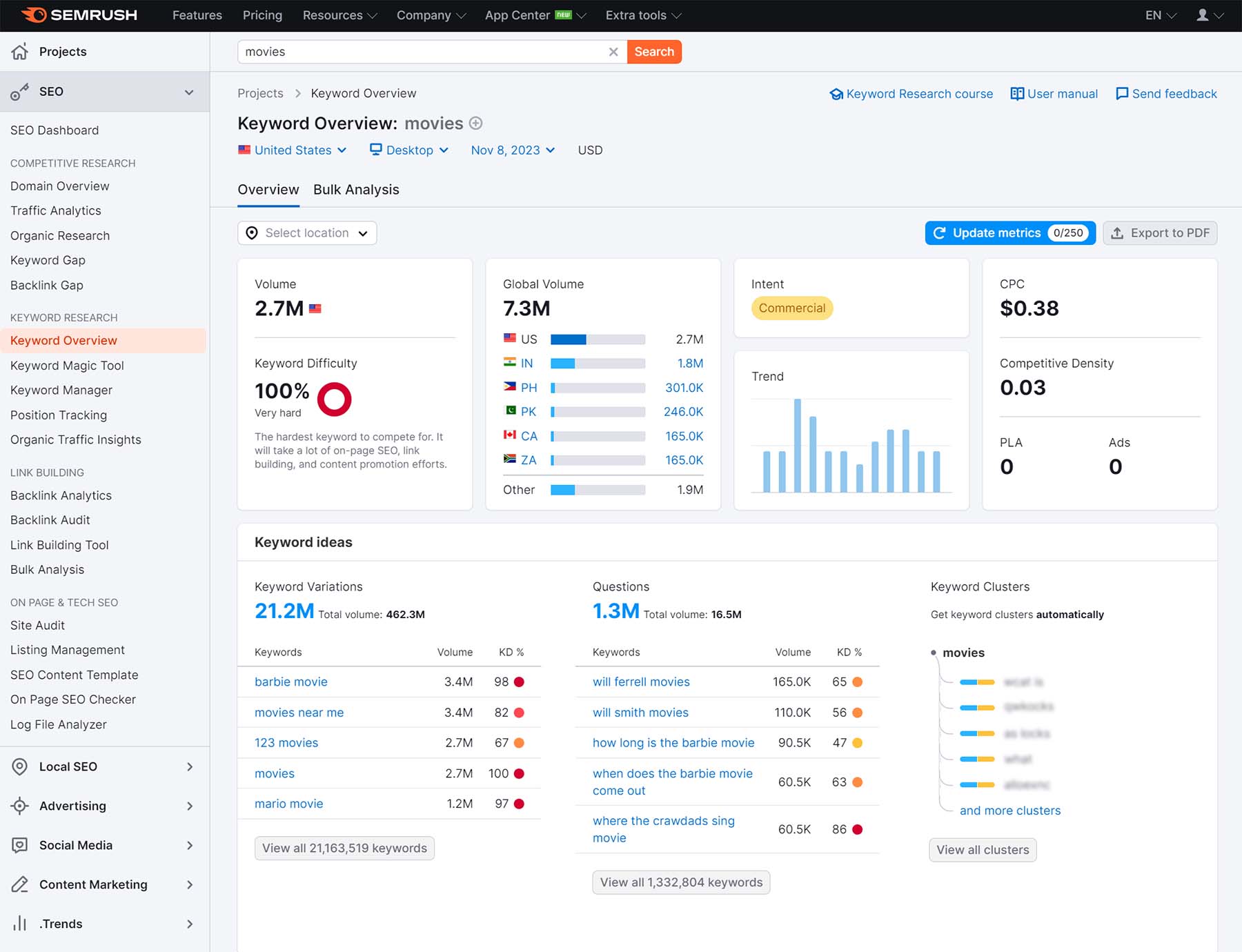
SEMrush is a powerful SEO and competitive analysis tool.
 
SEMrush keyword overview dashboard for “movies” showing search volume, keyword difficulty, CPC, trends, and related keyword ideas for SEO analysis
Key features:
  • Keyword tracking
  • Site audits
  • Backlink analysis
  • Competitor insights
Best use: Improving search rankings and identifying content opportunities.

HubSpot
HubSpot is an all-in-one marketing automation platform.

Key features:
  • Lead tracking
  • Email automation
  • CRM integration
  • Conversion analytics
Best use: Managing the full customer journey from first touch to conversion.

Optimization Strategies

Optimization is an ongoing process. The goal is to continuously refine your content to improve performance over time.

1. Update Outdated Content
Content can lose relevance over time. Regular updates help maintain rankings and engagement.

What to update:
  • Statistics and data
  • Keywords
  • Internal links
  • CTAs
Impact: Improved SEO rankings and sustained traffic.

2. Improve SEO
SEO optimization ensures your content remains competitive in search results.

Key actions:
  • Optimize for new keywords.
  • Improve meta tags
  • Enhance internal linking
  • Increase page speed
Impact: Higher visibility and more organic traffic.

3. Test CTAs (Call-to-Actions)
CTAs play a critical role in conversions. Small changes can lead to significant improvements.

What to test:
  • CTA wording
  • Placement on the page
  • Button design
  • Offer type (e.g., free guide vs consultation)
Impact: Higher conversion rates and better lead generation.

Continuous Improvement Cycle

A successful Content Marketing Strategy Guide follows a continuous loop:
  1. Publish content
  2. Measure performance
  3. Analyze data
  4. Optimize content
  5. Repeat
This cycle ensures your content becomes more effective over time.
 
Bottom line: If you measure your results, you can improve them. Using data to optimize is the key to making your content work for your business.

Advanced Strategies to Maximize Conversions

After you’ve built a strong foundation, you can take your Content Marketing Strategy Guide to the next level with advanced techniques. These methods help you get more from your content, personalize the experience, and make every interaction count.

1. Content Repurposing

Content repurposing is one of the most effective ways to maximize ROI without constantly creating new content from scratch. Instead of producing a single piece of content and moving on, you transform it into multiple formats to reach different audiences across platforms.

For example, a single blog post can be repurposed into:
  • Short-form social media posts
  • A YouTube video or webinar
  • An infographic
  • An email newsletter series
  • A downloadable guide or PDF

Why it works:
People like to get content in different ways. Some like to read, others like to watch or listen. Repurposing helps you reach everyone in the way they prefer.

Best practices:
  • Identify high-performing content and repurpose it first.
  • Adapt content format for each platform (don’t just copy-paste)
  • Update and improve content during repurposing.
Impact:
Increases reach, saves time, and improves overall content ROI.

2. Personalization

Personalization is about delivering the right content to the right person at the right time. Instead of a one-size-fits-all approach, you tailor your messaging to user behavior, preferences, and their stage in the buyer journey.

Examples of personalization include:
  • Showing different content based on user location
  • Recommending articles based on past behavior
  • Sending targeted email campaigns
  • Displaying dynamic website content

Why it works:
When people get content that feels relevant to them, they’re more likely to engage and take action.

Best practices:
  • Segment your audience into groups.
  • Use behavioral data (clicks, visits, downloads)
  • Personalize email campaigns and landing pages.
Impact:
Improves engagement, builds stronger relationships, and increases conversions.

3. Automation

Marketing automation allows you to scale your efforts while maintaining consistency. Instead of manually handling every interaction, automation tools manage repetitive tasks and nurture leads efficiently.
 
Digital automation concept interface with hand interacting on virtual screen, showing icons for AI, data, cloud computing, and smart technology integration
Common automation use cases:
  • Email drip campaigns
  • Lead nurturing workflows
  • Automated follow-ups
  • Content scheduling
Why it works:
Automation makes sure you don’t miss any leads and that everyone gets the right message at the right time.

Best practices:
  • Map out your customer journey before automating.
  • Use triggers based on user behavior.
  • Continuously monitor and optimize workflows.
Impact:
Saves time, increases efficiency, and improves lead conversion rates.

4. Lead Magnets

Lead magnets are valuable resources offered in exchange for a user’s contact information. They are a critical component of any conversion-focused Content Marketing Strategy Guide.

Examples of effective lead magnets:
  • Ebooks and guides
  • Checklists and templates
  • Free tools or calculators
  • Webinars and courses
Why it works:
People are more likely to share their contact info if they get something valuable right away.

Best practices:
  • Align the lead magnet with your audience’s needs.
  • Keep it highly relevant to your content.
  • Make access simple and fast.
Impact:
Generates qualified leads and builds your email list.

5. Conversion Rate Optimization (CRO)

Conversion Rate Optimization focuses on improving the percentage of users who take a desired action. Instead of increasing traffic, CRO ensures you get more value from your existing audience.

Key areas to optimize:
  • Landing page design
  • CTA placement and wording
  • Page load speed
  • User experience (UX)
Why it works:
Even small changes that boost your conversion rate can make a big difference in your revenue.

Best practices:
  • Run A/B tests on headlines and CTAs
  • Simplify forms and reduce friction.
  • Use social proof (testimonials, reviews)
  • Optimize for mobile users.
Impact:
Higher conversions, better user experience, and increased ROI.

Final Insight
Advanced strategies are what set great content marketing apart from the rest. When you use repurposing, personalization, automation, lead magnets, and CRO together, your Content Marketing Strategy Guide can drive real, scalable growth.

Bottom line: Don’t just make content. Improve every step to turn visitors into customers.

Real-World Examples of Content Marketing Success

Example 1: HubSpot
HubSpot built a massive audience through educational content, becoming a leader in inbound marketing.

Example 2: Neil Patel
By consistently publishing SEO-focused content, Neil Patel established authority and generated millions of monthly visitors.

Example 3: Airbnb
Airbnb uses storytelling and user-generated content to engage and convert audiences.
These examples show that a strong Content Marketing Strategy Guide can lead to big results.

Common Mistakes to Avoid

  • Lack of strategy
  • Ignoring SEO
  • Inconsistent posting
  • Weak CTAs
  • Poor audience targeting
If you avoid these mistakes, you’ll have a much better chance of succeeding.

FAQs About Content Marketing Strategy Guide

1. What is a Content Marketing Strategy Guide?
It is a structured plan for creating and distributing content to achieve business goals.

2. How long does content marketing take to work?
Typically, 3–6 months for noticeable results.

3. What type of content converts best?
Educational and solution-focused content performs best.
 
4. Is content marketing expensive?
It is cost-effective compared to paid advertising in the long run.

5. How often should I publish content?
Consistency is more important than how often you post. Focus on sharing high-quality content regularly.

Conclusion & Call to Action

A strong Content Marketing Strategy Guide isn’t just nice to have. It’s essential for any business that wants to grow online today.

It turns your content from random posts into a clear, repeatable system that drives traffic, builds trust, and converts leads into customers.

But to build and run a great content strategy, you need expertise, consistency, and a good understanding of SEO and your audience.

🚀 Ready to turn your content into a growth engine?
 
Excell Banner
At Excell, we specialize in creating high-converting, data-driven content marketing strategies that deliver real results.

👉 Whether you need SEO blogs, a full content system, or conversion-focused campaigns, we’re here to help.

🔥 Contact us today and Book your free discovery call to get done for your services and start turning your content into measurable revenue.


Contact us:
EXCELL INDUSTRIES LLC
6420 Richmond Ave., Ste 470
Houston, TX, USA
Phone: +1 832-850-4292
Email: info@excellofficial.com
Share the Post:

Related Posts

This Headline Grabs Visitors’ Attention

A short description introducing your business and the services to visitors.
top

Inactive