Table of Contents:
- Understanding Technical SEO in 2026
- Why Technical SEO Matters More Than Ever
- Website Crawlability & Indexation Checklist (2026)
- Core Web Vitals & Performance Optimization
- Mobile-First & Cross-Device Optimization
- URL Structure & Site Architecture Best Practices
- HTTPS, Security & Trust Signals
- Structured Data & Schema Markup
- JavaScript SEO & Rendering
- Image, Video & Media Optimization
- International & Multilingual Technical SEO
- Log File Analysis & Crawl Budget Optimization
- AI Search, SGE & Technical SEO Readiness
- Technical SEO Automation & Monitoring
- Common Technical SEO Mistakes to Avoid in 2026
- 5 Key Technical SEO Questions Answered
- Final Technical SEO Checklist Summary
- Why Excell Is Your Technical SEO Partner for 2026
- Strong Call to Action
1. Understanding Technical SEO in 2026
How Search Engines Evaluate Websites in 2026
1. Page Speed Across Devices
- Smartphones
- Tablets
- Older devices
- Slower network conditions
2. JavaScript Execution and Rendering
- Whether critical content loads without user interaction
- How efficiently JavaScript is executed
- Whether rendering delays block meaningful content
3. User Experience (UX) Signals
- Interaction responsiveness
- Visual stability
- Navigation clarity
- Accessibility compliance
4. Security Protocols and Trust Infrastructure
- HTTPS implementation
- Certificate validity
- Protection against malicious scripts
- Safe data handling practices
5. Structured Data Accuracy
- Schema completeness
- Correct property usage
- Consistency between structured data and visible content
- Clear content hierarchy
- Logical HTML structure
- Descriptive metadata
- Machine-readable signals
Why Technical SEO Is a Long-Term Investment
- Faster indexing of new content
- Greater crawl efficiency
- Improved ranking stability
- Eligibility for AI-powered search results
- Better conversion performance
2. Why Technical SEO Matters More Than Ever

- Deliver fast, frictionless user experiences
- Reduce low-quality or unreliable results.
- Provide instant, accurate answers through AI-generated responses.
- Surface content from trustworthy, well-structured sources
The Consequences of Poor Technical SEO
1. Losing Rankings Despite Great Content
2. Indexing Delays and Crawl Inefficiencies
- Poor internal linking
- Bloated JavaScript
- Duplicate URLs
- Crawl traps
3. Failure to Appear in AI-Powered Search Results
4. Poor Mobile and Cross-Device Experiences
- Load slowly on mobile.
- Have layout shifts
- Use intrusive pop-ups
- Offer poor navigation
Technical SEO as a Competitive Differentiator
- Faster load times
- Better Core Web Vitals
- Cleaner architecture
- Stronger security
- More accurate structured data
Technical SEO and Long-Term Ranking Stability
- Recover faster from updates.
- Maintain stable rankings
- Scale content more efficiently
- Adapt quickly to new search features.
Why Businesses Can No Longer Ignore Technical SEO
- Reduced visibility in AI search results
- Lower engagement and higher bounce rates
- Missed indexing opportunities
- Increased dependence on paid traffic
- Sustainable organic growth
- Higher conversion rates
- Stronger brand authority
- Better ROI from content efforts
3. Website Crawlability & Indexation Checklist (2026)
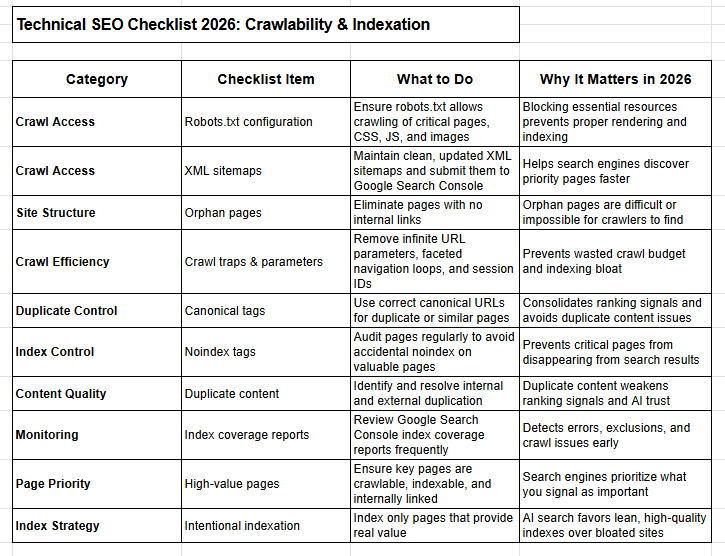
A site that can’t be crawled or indexed won’t rank, period.
Search engines must be able to efficiently discover, crawl, and index your most important pages before rankings are even possible.
4. Core Web Vitals & Performance Optimization
Key Metrics to Optimize:
- Largest Contentful Paint (LCP): < 2.5 seconds
- Interaction to Next Paint (INP): < 200 ms
- Cumulative Layout Shift (CLS): < 0.1
- Use CDN delivery
- Compress CSS, JS, and HTML
- Implement lazy loading
- Reduce third-party scripts
- Optimize server response times.
5. Mobile-First & Cross-Device Optimization
Why Mobile Optimization Is Critical in 2026
- Mobile is the dominant search environment.
- AI-powered search results favor mobile-friendly sources.
- Core Web Vitals are measured primarily on mobile performance.
- Poor mobile UX directly correlates with high bounce rates and low engagement.
Mobile SEO Checklist Explained
1. Fully Responsive Design
- Smartphones
- Tablets
- Laptops
- Large desktop screens
2. Identical Content on Desktop and Mobile
- Same headings, text, and metadata
- Same structured data
- Same internal links
- Same primary content hierarchy
3. Touch-Friendly Navigation
- Easy to tap
- Properly spaced
- Clearly visible
- Intuitive to use
4. Fast Mobile Load Speeds
- Time to first interaction
- Visual stability
- Input responsiveness
- Large images
- Unoptimized JavaScript
- Heavy third-party scripts
- Inefficient fonts
5. No Intrusive Interstitials
- Full-screen pop-ups on page load
- Aggressive email signup prompts
- Obstructive ads
Cross-Device Consistency Matters
- Smartphones
- Tablets
- Desktops
- Hybrid devices
- URLs behave consistently
- Content renders correctly
- Tracking and analytics remain accurate.
Mobile SEO and AI Search Visibility
- Fast
- Accessible
- Easy to navigate
- Structurally clean
Why Mobile Optimization Is Non-Negotiable
- Lower rankings
- Reduced AI search exposure
- Poor user engagement
- Lost conversions
6. URL Structure & Site Architecture Best Practices
URL structure and site architecture form the organizational backbone of your website. They determine how users navigate your content and how efficiently search engines crawl, understand, and prioritize your pages. In 2026, clean architecture is no longer just a usability concern; it is a critical technical SEO ranking factor.
Search engines rely on logical structure to interpret relationships between pages, identify the importance of content, and allocate crawl budget effectively. A poorly structured website creates confusion for both users and crawlers, while a well-organized site sends clear signals about relevance, authority, and hierarchy.
Why URL Structure and Architecture Matter in 2026
Search engines today evaluate websites holistically. They don’t just analyze individual pages; they assess how content is connected, categorized, and prioritized.
Strong site architecture helps search engines:
- Understand topical relevance
- Identify the cornerstone and supporting content.
- Crawl important pages more frequently.
- Reduce indexation of low-value URLs
URL Structure & Architecture Best Practices Explained
1. Logical Category Hierarchy
Your website should be organized into clear, meaningful categories that reflect how users search and how topics relate to one another.
A logical hierarchy:
- Groups related content together.
- Clarifies topical authority
- Helps crawlers understand content relationships
2. Flat Structure (Important Pages Within Three Clicks)
A flat site structure ensures that important pages are easily accessible from the homepage within three clicks or fewer.
Why this matters:
- Search engines prioritize pages closer to the homepage.
- Deep pages receive less crawl attention.
- Link equity flows more effectively in flatter structures.
3. Short, Keyword-Relevant URLs

- Use readable words instead of IDs or codes.
- Avoid excessive folders
- Include primary keywords naturally.
4. No Unnecessary Parameters
- Generate infinite URL variations.
- Waste crawl budget
- Index low-value parameterized pages
5. Consistent Internal Linking
- Uses descriptive anchor text
- Connects related pages logically
- Highlights priority content
- Avoids broken or redirected links
How Good Architecture Improves Crawl Efficiency
- Reach important pages faster.
- Avoid low-value or duplicate URLs
- Index new content more efficiently
Site Architecture and AI Search
- Be understood by AI models.
- Be referenced in AI-generated answers.
- Appear in zero-click and featured results.
Long-Term SEO Benefits of Clean Architecture
- Easier content expansion
- Faster technical audits
- Better user engagement
- More stable rankings during algorithm updates
7. HTTPS, Security & Trust Signals
Security Checklist:
- HTTPS enabled sitewide
- No mixed content warnings
- Updated SSL certificates
- Secure forms & payment gateways
- Protection against malware
8. Structured Data & Schema Markup
High-Value Schema Types:
- Organization
- FAQ
- Article
- Product
- Review
- Local Business
- Rich results
- AI citations
- Click-through rates
9. JavaScript SEO & Rendering
JavaScript SEO Checklist:
- Server-side or hybrid rendering
- Avoid blocking scripts
- Ensure content loads without user interaction.
- Test with Google’s URL Inspection Tool
10. Image, Video & Media Optimization
Media impacts both performance and discoverability.
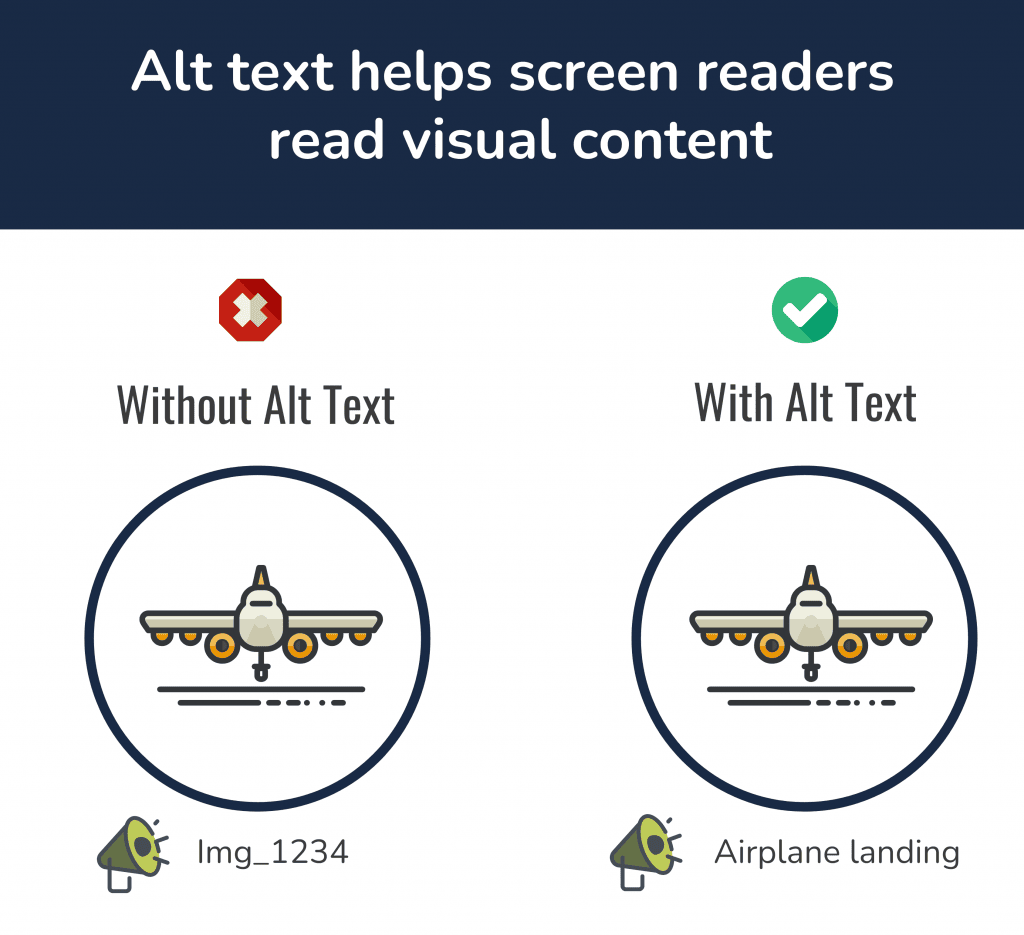
- Use next-gen formats (WebP, AVIF)
- Add descriptive alt text.
- Compress images without quality loss.
- Optimize video loading
- Implement image sitemaps
11. International & Multilingual Technical SEO
International SEO Checklist:
- Proper hreflang tags
- Country-specific URLs
- Localized content (not auto-translated)
- Consistent canonicalization
12. Log File Analysis & Crawl Budget Optimization
Why It Matters:
- Identify wasted crawl budget.
- Fix crawl inefficiencies
- Prioritize important pages
13. AI Search, SGE & Technical SEO Readiness
- Fast-loading pages
- Clear structure
- Clean schema
- Reliable sources
14. Technical SEO Automation & Monitoring
Tools to Use:
- Google Search Console
- Screaming Frog
- PageSpeed Insights
- Log analyzers
- Automated alerts
15. Common Technical SEO Mistakes to Avoid in 2026
- Ignoring mobile UX
- Bloated plugins and scripts
- Poor JavaScript handling
- Duplicate URLs
- Outdated schema
- Slow hosting
16. 5 Key Technical SEO Questions Answered
2. How often should I audit my technical SEO?
3. Does technical SEO affect AI search results?
4. Can content rank without strong technical SEO?
5. Is technical SEO a one-time task?
17. Final Technical SEO Checklist Summary
- Crawlability
- Indexation control
- Performance optimization
- Mobile-first UX
- Secure infrastructure
- Structured data
- AI readiness
18. Why Excell Is Your Technical SEO Partner for 2026
- Fix complex technical SEO issues.
- Improve Core Web Vitals
- Optimize for AI search and SGE.
- Build long-term organic authority.
19. Strong Call to Action

👉 Schedule your technical SEO audit now and stay ahead of competitors before the next algorithm update hits.
Contact us:
6420 Richmond Ave., Ste 470
Houston, TX, USA
Phone: +1 832-850-4292
Email: info@excellofficial.com