


If your law practice recently started investing in SEO, you may be wondering how long it takes. Most companies should think in months, not days or weeks. You may see some early benefits, but it takes ongoing effort to continually grow your ranks, quality organic traffic, local awareness and leads. Google says some website updates won’t have an immediate impact, with some taking hours and others months to take effect.
“Many law firms expect to see measurable progress in three to six months, with greater benefits over six to twelve months and beyond. An Ahrefs survey of thousands of marketers and SEO specialists found that SEO outcomes typically took three to six months.
No global countdown clock exists.
A personal injury attorney entering a highly competitive metropolitan area may have a longer road than an estate planning firm targeting many smaller regions. Factors affecting timing include domain age, authority, website quality, backlink profile, content, location, competition, technical health, reviews, and SEO investment.
Understanding those elements helps law firms set better expectations, monitor success appropriately, and avoid terminating a promising SEO campaign early.
Table of Content:
- How Long Does SEO Take for Law Firms?
- Why Law Firm SEO Takes Time
- A Realistic Month-by-Month SEO Timeline
- What Factors Affect SEO Results?
- Local SEO vs. Organic SEO
- How Practice Area Competition Changes the Timeline
- Five Important Questions About Law Firm SEO
- Signs Your SEO Strategy Is Working
- Why SEO Campaigns Sometimes Fail
- Can You Speed Up Law Firm SEO?
- SEO vs. PPC for Law Firms
- What to Expect After 12 Month
- SEO ROI: How Should Law Firms Measure?
- A Handy Law Firm SEO Timeline
- Is SEO Worth the Wait for Law Firms?
- Final Thoughts
How Long Does SEO Take for Law Firms?
The SEO process for law firms generally consists of three steps:

- Months 1-3: Research, technical upgrades, content creation, local optimization and climbing in the rankings.
- Months 4-6: Keyword visibility, impressions, local ranks and organic leads growth increase.
- Months 6-12: More traffic, competitive term #1 rankings, topical authority and lead generation.
- 12+ months: Growth, authority, keyword coverage & competitive optimization.
None of these numbers are guaranteed. The planning ranges are reasonable.
A law company with a solid website, hundreds of relevant backlinks, a good Google Business Profile, great reviews, and established content may get speedier results.
A new legal practice launching a domain in Los Angeles, Houston, Chicago, Miami, or another competitive market may take longer to rank on page one for high-value terms.
There are many reasons why SEO for law firms is uncertain in the amount of time it takes. This situation is similar to asking how long it takes for a company to dominate its market. The answer depends on your starting point and opponent.
SEO is more than simply writing articles and waiting.
An excellent plan might be: SEO Technical Search intent and keyword research Practice Area Pages Location pages law blog posts Optimizing your Google Business Profile Local citations Building reviews and reputation Link acquisition Link internally Enhanced website usability Conversion optimization Measuring performance Updates on content Competitor analysis Each part boosts your business’s search visibility.
Why Law Firm SEO Takes Time?
For a page to be able to compete with other pages in search results, it first needs to be found, crawled, indexed, interpreted and evaluated by search engines.
According to Google, SEO helps search engines analyze content and helps consumers find relevant websites. Google states that there is no magic trick to ranking a website first.
Law firms also face fierce competition.
Someone seeking:
- local personal injury attorney
- auto accident lawyer
- Divorce lawyer
- criminal defense attorney
- a bankruptcy attorney
- probate lawyer
- Workers’ comp attorney
Competing firms may value it highly.
You have multiple attorneys, established businesses, directories, legal publishers, lead generation agencies, and national brands all competing for the same search.
The law is based on faith.
The law can affect a person’s finances, rights, family and future. Google refers to topics that have a high potential to impact health, money, safety or social wellbeing as Your Money or Your Life (YMYL) topics and prefers to offer useful, reliable, people-first information about them.
Rehashing the basics from competitors’ websites won’t give law firms a sustainable advantage.
Legal content should be informative and credible by including the following:
- Correct explanations
- Attorney review as necessary
- Clear authorship
- Specific jurisdictional data
- Experienced legal insights
- Unique examples
- Statistics that matter
- Bios of authors
- Sources
- Information updated
- Clear contact info
- Strong practice-area expertise
Google advises content creators to evaluate the “Who, How, and Why” of their content and prioritize it for people rather than rankings.
That level of authority takes time and dedication.
A Realistic Month-by-Month SEO Timeline
The normal legal firm can expect these results from a well-structured SEO campaign.
First Month: SEO Audit and Strategy
The first month is generally crucial.
Before trying to boost ranks, an SEO team must assess the company’s position.
The process may include:
Technical SEO Audit
Look for website issues with:
- Crawling
- Indexation
- Architecture of site
- Redirects
- Duplicated pages
- Broken links
- Canonicalization
- Pages’ performance
- Mobile usability
- Internal links
- XML sitemaps
- Robot orders
- Structured data
- HTTPS
- Technical core issues
Technical fixes strengthen everything that follows.
Keyword Research
Law firms should not target terms by search volume.

Better keyword strategies consider:
- Get search intent
- Practice area
- Geographic location
- Competition
- Conversion potential
- The user journey
- Variations of searches
A personal injury firm may target both broad terms like “personal injury lawyer” and more targeted ones like the following:
- rear-end collision attorney
- Lawyer for pedestrian accident
- legal representative
- Motorcycle accident lawyer
- local truck accident attorney
Longer, more precise searches might yield valuable results while rankings grow.
Competitor Analysis
Not all SEO competitors are business competitors. Organically, the companies above you in Google matter.
Analysis may involve:
- Their most viewed pages
- Content richness
- Backlink portfolio
- Geographic strategy
- Site architecture
- Testimonials
- Local search visibility
- Internal
- Linking
- Keywords included
The first month may not bring you more traffic, but it sets the stage for success.
Monthly 2: Website Optimization and Content Creation The implementation of the second month is becoming clearer.
Rewrite or expand existing pages and build missing practice-area pages.
Websites for personal injuries may need separate sections for:
- Car crashes
- Truck crashes
- Motorcycle crashes
- Accidents on foot
- Bicycle accidents
- Unjust death
- Liability for premises
- Dog bites
- Ridesharing crashes
Each page should answer client questions.
Google recommends generating content that provides a detailed, complete treatment of a topic and leaves readers feeling empowered to achieve their goal.
That idea is crucial for legal websites.
A 300-word site proclaiming, “We handle car accidents; contact us today,” may be meaningless.
Stronger pages might explain the following:
- How accident victims should act
- Who is liable?
- Evidence matters.
- Common insurance tricks
- Damages available
- Deadlines for filing
- Frequently asked questions
- A lawyer can help.
Internal linking and on-site SEO changes should also strengthen relevant page links.
Month 3: Indexing, Local SEO, Early Ranking
Some firms detect signs of improvement by the third month.
They may include:
- Google Search Console impressions rise
- New top-100 keywords
- Existing keywords rising
- Indexing more pages
- Google Business Profile activity rises
- Better ranks for low-competition phrases
- More organic site visitors
Companies sometimes think that no page-one rankings indicate no growth; therefore, this step is crucial.
SEO seldom goes from 0 to 1 overnight.
A keyword can become the following:
Positions 82, 54, 31, 18, 9, and 4.
That entire progression counts. Similar rules apply to local SEO. A company may initially appear solely in a small area around its office and then expand.
Months 4–6: Momentum Grows
Months four through six are when SEO becomes visible for many initiatives. Content published earlier has had more time to be crawled, indexed, reviewed, linked within, and sometimes cited outside.
Companies may rank for greater clusters of terms.
For example, an optimized vehicle accident site might be relevant for variations that include:
- car accident attorney
- auto accident lawyer
- traffic collision lawyer
- car crash attorney
- injury lawyer after a car accident
- automobile accident attorney
Google’s smart systems do not expect authors to repeat every keyword variation word for word. Google suggests writing in a natural way for readers, instead of trying to include every variation of a search.
It’s time for SEO teams to evaluate what works and change.
Some questions:
- Pages getting impressions?
- Which phrases approach page 1?
- Which pages have high impressions but low CTR?
- Which regions are improving?
- Which content gaps remain?
- Which competitors gain visibility?
- Need more links on which pages?
- Which pages generate leads?
Data should drive optimization.
Better organic lead generation for months 6–12.
A well-executed campaign can gain strength between months 6 and 12.
The website has had time to grow in search results. Depending on the website and market, the firm may rank for hundreds or thousands of relevant questions.
Strong campaigns compound. A new blog post can link to a key practice-area site. That article may get links. Links can contribute to the authority of the site.
The practice area page needs to be better.
Better rankings = more visitors.
Visitors get in touch with the company. Company brand awareness grows. Direct searches for the company increase. The process reinforces itself.
This strategy is one reason law firms should consider SEO a long-term acquisition channel rather than a brief advertising effort.
Building a solid search presence after 12 months
When a company hits page one, SEO continues.
Competition will continue:
- New page publishing
- Creating links
- Getting reviews
- Content updates
- Opening new offices
- Improve websites
- Targeting new keywords
Search results evolve too. Google says rankings change because user expectations, site content, and search systems do.
In the second year, SEO should focus on protecting the company’s positions and increasing visibility.
That includes:
- Updating successful pages
- More cities to expand
- Legal resource development
- Creating topic clusters
- Increase conversions
- Improved lawyer profiles
- Looking for digital
- PR opportunities
- Enhancing Local Government
- Catering to new search habits
- Optimizing AI-driven discoveries .
SEO becomes a competitive weapon.
What Factors Affect SEO Results?
It’s not just the calendar that impacts law firm SEO timelines.
1. Age & Authority
of the Site Backlinks, indexed pages, brand searches, credibility – a 10-year-old law firm website can have all that.
New domains don’t have much search history.
It takes time to create authority, but success is attainable.
2. Competition
Ranking for “estate planning lawyer in [small city]” may differ from “personal injury lawyer Los Angeles.”
Search volume does not indicate difficulty. You compete with sites at high positions.
If sites have:
- Referring domains: thousands
- Veteran content libraries
- Powerful brands
- Big SEO budgets
- Good reviews
Your campaign needs relevance and authority to compete.
3. Current Website Quality
A legal company with a slow, confused, technically problematic website may need foundational maintenance.
Slow growth: Duplicate content, indexing issues, poor site architecture, mobile usability or thin practice pages can all lead to slow growth. Duplicate content, indexing issues, poor site architecture, mobile usability issues, or thin practice pages can all cause slow growth.
4. Good Content

Published articles are not always better. Google says it’s better to give content to people rather than flood search engines with stuff.
Ten great resources will do a law firm more long term good than 100 shallow posts.
Quality legal information should answer client questions and demonstrate the firm’s expertise.
5. Links Backlinks
Backlinks are still relevant for the visibility of a website and web links. It’s not about the number of links, but their quality.
Opportunities could be: Online PR Community groups Professional associations Real law directories Civic Collaborations news reporting Research Article Appropriate scholarships or educational tools Extreme link strategies are risky.
6. Market Geography
A legal practice may do well in one suburb and not do so well in another large city.
So, SEO strategies should be spatial in measuring effectiveness, not using a state as one market.
7. Invest and Act
A corporation that drops an article every few months moves differently than continually improving:
- Technical SEO
- Practice pages
- Local pages
- Content
- Links
- Reviews
- UX
- Conversion tracking
SEO timelines depend on both competition and execution.
Local SEO vs. Organic SEO
The two biggest areas where Google competes with law firms are:
Organic Search Results & Local Search Visibility.
Not the same, but similar.
Local SEO
Local SEO is about geography queries such as “criminal defense lawyer in the area.”
Some key areas might be:
- Google Business
- Profile Optimization
- Reviews
- Business information consistency
- Local Importance
- Pages for locations
- Local back links
- Importance of Location
Exposure of a firm can vary greatly by searcher location.
Organic SEO
Organic SEO targets traditional website outcomes.
Important aspects may include:
- Quality content
- Backlinks
- Architecture of site
- Get search intent
- Technical SEO
- Linking internally
- Topical depth
- Page relevance
A comprehensive marketing plan for a law firm should include both.
How Practice Area Competition Changes the Timeline?
Not all legal fields have SEO issues.
Practice areas with high competition include:
- Injury to self
- Motor vehicle accidents
- Mass torts
- Criminal defense
- DUI defense
- Family law
- Bankruptcy
- Immigration
Why? Because a single client might be valuable, corporations invest much in online marketing. That boosts competition.
A specialist practice targeting a small geographic market may grow quicker than a major metropolitan personal injury firm.
This is yet another reason to be suspicious of promises like “We’ll get you to number one in 30 days.”
You don’t control search results. Google has said following SEO best practices does not guaranty a site’s ranking.
Five Important Questions About Law Firm SEO
Question 1: Can a law firm get SEO results in 30 days?
Answer: Yes, but not always the results a company desires.
The first 30 days of a campaign may improve:
- Healthy technical webpage
- Indexation
- Page titles
- Linking internally
- Local listings
- Existing ranks
- Google Search Console visibility
A poorly optimized yet authoritative page may move swiftly after optimization.
Expecting a new website to dominate competitive attorney keywords in one month is unreasonable.
Google said search results can take hours to months to incorporate changes. Thirty days should be considered a foundation-building stage, not an SEO decision.
Question 2: Why Is My Law Firm Getting More Organic Traffic But Fewer Cases?
Answer: Traffic is not qualified leads.
An SEO strategy can bring in visitors, but not signed cases, if it goes after the wrong queries, or doesn’t convert people.
Suppose a personal injury firm publishes a national traffic analytics piece with 10,000 monthly visits.
Visitors may include:
- Students
- Researchers
- Journalists
- People outside the firm’s state
- Insurance pros
Impressive traffic, yet most visitors may never need representation.
Compare that to a page with 300 monthly visitors searching for the following:
“nearby truck accident lawyer.”
Commercial purpose may be higher among those 300 visitors.
Therefore, law firms should measure the following:
- A qualified call
- Contact form submissions
- Requests for consultation
- Signed cases
- Cost/qualified lead
- Organic conversion
Only traffic that supports company goals is valuable.
Question 3: How Often Should Law Firms Post SEO Content?
Answer: No firm must publish a certain number of articles.
More important than consistency is quality and strategy. Publishing 20 weak articles each month to meet a content requirement wastes resources.
Better strategies start with identifying prospective clients’ needs.
Content could answer the following:
- What is the personal injury claim deadline?
- The other driver has no insurance what happens?
- Divorce custody: Who gets it?
- What should I do after arrest?
- Can creditors seize my home?
- Dying without a will – what now?
Each piece should have a function. Google advises against creating loads of search-engine-first material, with the goal of ranking particular pages.
Useful material for legal firms should be at the heart of a wider authority strategy, not a publishing schedule.
Question 4: Should a Law Firm Stop SEO After Page One?
Answer: No.
Page-one positions are accomplishments, not property. Your competitors can outdo and improve your website.
Even current pages can become obsolete. Google recommends auditing and updating old content.
SEO can then focus on the following once you have achieved high rankings:
- Top keyword protection
- Updating old posts
- Boosting conversions
- Adding additional questions
- Building stronger backlinks
- Increase in local rank
- Expanded topics coverage
- Changes competitors are making
Turning off SEO entirely gives competitors a chance to catch up.
Question 5: When Should a Law Firm Begin Monitoring SEO Results?
Law firms should start monitoring SEO from the beginning but need several months of data to assess long-term performance.
That is a very important difference.
“Speed in measurement, but slow in achievement.
In months one through three, assess leading indicators like the following:
- Technological advances
- Page index
- Keyword hits
- Movement in rankings
- Visibility locally
- Performance of new content
In months four through six, assess more:
- Organic sessions
- Page-one rankings
- Qualified queries
- Calls
- Form submissions
Business indicators become crucial after six months:
- Qualified leads
- Signed clients
- Rate of conversion
- Per-acquisition cost
- Trackable organic search revenue
SEO should help the legal company thrive, not just boost rankings.
Signs Your SEO Strategy Is Working
You don’t need your company to be #1 to see success.
SEO campaigns can indicate progress in several ways.
More Search Impressions
This is often the first outward sign of development.
Increase in Keyword Rankings
Terms that move from page ten to page five, or from page three to page two, are making progress, even if they have not yet reached their final targets.
More keywords rank
A successful campaign increases site searches.
Non-Branded Organic Traffic Rises
Branded traffic comes from company name searches.
Your non-branded traffic may indicate that fresh prospects are finding you through legal searches.
Local visibility increases.
The company’s Google Business Profile might show up in more searches and places.
Increase in Qualified Leads
A key indicator is more potential clients reaching out to your legal company.
Why SEO Campaigns Sometimes Fail?
Longer waits don’t cure ineffective strategies.
Check why substantial development is missing after several months.
Mistargeted keywords
Ranking first for keywords nobody searches or searches without hiring intent doesn’t help your organization.
Generic or Thin Content
Replicating competitor legal content might not be able to differentiate.
Weak Technical Foundation
Stuff like broken internal links, duplicate pages, indexation problems and bad architecture can slow things down.
No Power
Perhaps the website content is good but the external authority is lower than competitors.
Ignoring local SEO
Ignoring local search can cost law firms leads.
Publish Without Strategy
A blog shouldn’t cover random legal matters. Content should make sense for practice areas and potential clients.
As an example:
Car Accident Lawyer
could access articles on:
- Post-crash actions
- Uninsured drivers
- Rear-end collision liability
- Insurance settlement errors
- Runaway vehicles
- Car accident evidence
It develops a cohesive information environment around the firm’s expertise.
Instead of Revenue, Measure Rankings
Rankings matter, but they don’t cover legal firm costs.
An SEO program should link visibility to:
Search, visit, inquiry, consultation, client.
Can You Speed Up Law Firm SEO?
You can eliminate delays but not force search engines to reward a website instantaneously.
Fix Tech Issues Early
Avoid months of content on a broken website.
Fix major crawling, indexing, architectural, performance, and usability issues early in the campaign.
Focus on High-Intent Pages.
Practice-area and service pages should be prioritized as they target users who are close to hiring an attorney.
Build Content Clusters
Don’t publish irrelevant publications, but build authoritative clusters around priority practice areas.
Create Better Internal Links

Important pages should not be hidden behind several clicks.
Internal links in context help consumers and search engines understand the relationship between content.
Improve Pages
Content creation isn’t always fast.
Pages in positions 8-20 can see big gains after improvements:
- Content
- Titles
- Internal linking
- Search intent alignment
- Supporting evidence
- User experience
Build Trust
Good referrals and mentions can really help a company’s online presence.
Don’t shortcut. Take quality.
Increase Conversions
SEO is more than just driving traffic.
Suppose we have two law firms that each get 2,000 organic visitors.
Firm A generates 1% inquiries.
Firm B converts 4%.
Firm B gets four times more inquiries without more traffic.
Therefore, SEO strategy should include:
- Clear calls to action
- To-call buttons
- Easy contact forms
- Trust signifies
- Biographies of attorneys
- Ethics-permitted testimonials
- Suitable legal and ethical case results
- Mobile usability
- Clear service descriptions
More traffic helps. Higher qualified cases are better.
SEO vs. PPC for Law Firms
Paid search and SEO have different time horizons.
PPC Boosts Visibility Rapidly
A good paid advertising campaign can begin to show ads soon after launch. That’s why PPC is valuable to enterprises that want that immediate exposure.
Paid traffic requires ongoing advertising. Stop paying for ads, and the paid visibility often ends.
SEO Takes Longer but Can Compound
SEO demands much more patience but successful content and rankings can continue gaining visibility without paying for every individual click.
For many legal companies, the strongest option is not necessarily SEO versus PPC.
It might be SEO plus PPC.
Paid search is good for capturing demand that’s ready now, while SEO builds an organic channel for acquisition over the longer term.
Data from each channel can also migrate to the other over time.
You may need strong organic sites on high converting keywords after PPC. SEO might be able to find questions testable by advertising.
What to Expect After 12 Month?
Suppose a company has done SEO for a year.
It should expect what? There is no guaranteed traffic or ranking aim because marketplaces differ greatly.
A mature campaign should have enough data to answer key questions.
Which Practice Areas Work Best?
Know which services create mostly organic content:
- Impressions
- Traffic
- Leads
- Consultations
- Cases
Which locations excel?
You need to know which geographic markets are expanding and where competitors are entrenched.
Clients Come From Which Content?
Informational content may draw readers.
Others may help conversions often. Understand the difference to prioritize future investment.
The biggest remaining opportunities?
Perhaps the company ranks 4-10 for valuable keywords.
Those terms may need more attention. A whole accident category may be empty.
Maybe competitors rule a nearby city. These discoveries become the next growth roadmap using SEO data.
SEO ROI: How Should Law Firms Measure?
“Law firms cannot judge SEO solely on the basis of ranking reports.
Useful measurements are: Organic Traffic What share of visitors are from unpaid search?
Organic Leads
Organic visitors generate how many calls and forms?
Qualified Leads
How many inquiries are truly situations the business would consider?
Consultations
Many organic leads schedule consultations?
Signed Cases
How many become customers?
Case Value
How much value does organic acquisition create for organizations that appropriately manage revenue attribution?
If low-value informative traffic drops and qualified leads rise, a law firm may lose traffic but improve business results.
SEO and law firms must agree on significant KPIs from the start.
A Handy Law Firm SEO Timeline
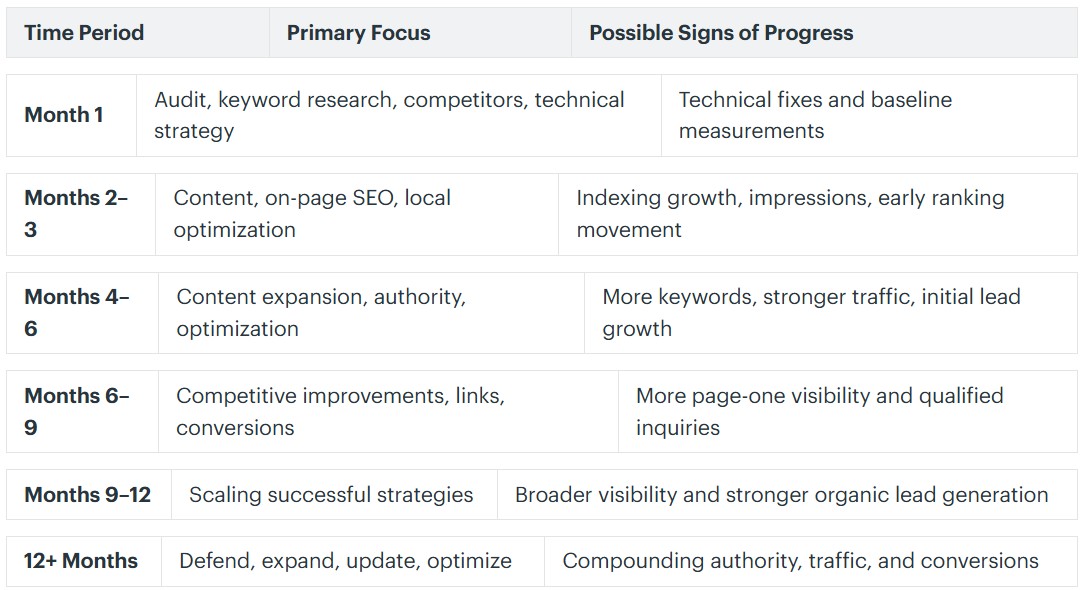
Possible indicators of progress. No credible SEO business should promise a ranking by a certain date.
There are just too many variables outside of an agency’s control.
Is SEO Worth the Wait for Law Firms?
Yes, for many organizations, the plan is worth it if it is based on business results. Consider how prospective clients increasingly seek legal aid.
Crash victims may search for:
Should I hire a lawyer after a vehicle accident?”
Later:
“How much is my car accident case worth?”
Then:
“car accident lawyer nearby.”
A complete SEO strategy can help a legal business be visible along that process.
The first article may introduce the company.
Second, it boosts confidence.
The practice-area page facilitates conversion.
The local listing has directions, reviews, and contact details.
Strong SEO provides an ecosystem where a legal firm can repeatedly surface when a prospective client requires relevant information, rather than treating each search as a keyword.
It takes time to get visibility. After establishing, it might be a marketing asset.
Final Thoughts
How long does law firm SEO take?
Early signs may appear within the first few months, but many organizations can expect three to six months before major SEO development becomes apparent and six to twelve months or longer for competitive growth.
The chronology depends on:
- Competition
- Website history
- A domain authority
- Technological health
- Quality content
- Backlinks
- Visibility locally
- Geographic market
- Practice-area challenge
- Budget
- Consistency
- Execution
Most importantly, SEO should not be assessed by how quickly one keyword tops the list.
A good law firm SEO program should generate visibility across dozens, hundreds, or thousands of client-relevant queries.
That takes planning, patience, measurement, and progress.
Google recommends that sites stop trying to game the search engines and instead focus on creating useful, reliable, people-first content. Real improvements take time.
Are you ready to turn Google searches into qualified leads? Team Up With Excel
Your prospects seek legal aid daily. They may find your law practice or your competitors.
With Excell, law firms can build strategic SEO campaigns that generate search visibility, online authority, high-intent prospects, and organic traffic that translate into significant revenue opportunities.
Legal SEO isn’t just about writing content and checking off keywords. Your firm’s growth goals require a holistic strategy that combines technical SEO, local search, valuable legal content, competitive research, authority building, and conversion optimization.
Excell can pinpoint opportunities for your law practice to grow organically if you are just starting in SEO, can’t get past page two, are in a competitive legal market, or want to get more value from an existing strategy.

Don’t let competitors control searches that could lead to new clients.
Contact us today and Book your free discovery call to get done for your services.
Contact us:
EXCELL INDUSTRIES LLC
6420 Richmond Ave., Ste 470
Houston, TX, USA
Phone: +1 832-850-4292
Email: info@excellofficial.com