


Table of Contents:
- Topical Authority in SEO: How to Build Trust and Rank Higher
- What Is Topical Authority in SEO?
- How Topical Authority Supports Google’s E-E-A-T Guidelines?
- Why Topical Authority Matters in Modern Search?
- How Google Understands Topics and Expertise?
- The Difference Between Domain Authority and Topical Authority
- Benefits of Building Topical Authority
- How to Build Topical Authority: A Step-by-Step Framework?
- Conducting Topic Research and Building a Topical Map
- Creating Pillar Pages and Content Clusters
- Internal Linking and Semantic SEO
- The Role of E-E-A-T in Topical Authority
- Content Quality and User Intent
- Building Backlinks That Support Topical Authority
- Measuring Your Topical Authority Progress
- Common Mistakes to Avoid
- Frequently Asked Questions About How to Build Topical Authority
- Final Thoughts
- Ready to Build Topical Authority and Dominate Your Industry
Topical Authority in SEO: How to Build Trust and Rank Higher
Search engine optimization (SEO) has changed significantly over the past 10 years. In the early days, getting a high Google ranking usually meant picking a keyword, using it many times on a page, and collecting as many backlinks as possible. While keywords and backlinks still matter, Google’s algorithms are now much more advanced. Today, search engines look for more than just keywords; they want to see if a website shows real expertise, authority, and trust in a specific subject. Because of this, topical authority has become a key part of modern SEO.
If you want to build topical authority, you are already thinking about one of the best long-term ways to improve your search visibility and grow your website. Instead of just ranking individual pages for separate keywords, topical authority is about making your website the go-to resource for an entire subject. When search engines see your site as a trusted source in your field, they are more likely to rank your content for many related searches.
In simple terms, topical authority is what sets apart websites that only rank for a few keywords from those that regularly appear at the top of search results. A site with strong topical authority can rank for tough keywords, get noticed for long-tail searches, and often have new content indexed and ranked faster because search engines already trust its expertise.
Topical authority has become increasingly important as Google works harder to deliver the best experience to users. Search engines no longer look at content by itself. They check how well your website covers a whole topic, answers user questions, and connects related ideas. So, just posting a few blog articles is not enough for good SEO results anymore. Now, you need a clear strategy that shows depth, variety, and consistency across all your content.
Organizations that build strong topical authority often see benefits that go well beyond better rankings. These include:
- Higher rankings for competitive keywords
- Increased organic traffic from multiple search intents
- Greater visibility across an entire topic cluster
- Improved lead generation and conversions
- Enhanced brand recognition and credibility
- Stronger user engagement and retention
- Increased trust from both users and search engines
- Better resilience against algorithm updates
- Faster ranking potential for newly published content
For example, imagine two websites in digital marketing. One site posts articles now and then about SEO, social media, paid ads, and general business topics without a clear plan. The other site focuses solely on SEO and provides detailed content on keyword research, technical SEO, local SEO, link building, on-page optimization, algorithm updates, SEO tools, reporting, and case studies. Over time, Google is much more likely to see the second site as an authority on SEO because it shows expertise and covers the topic in depth.
This idea works in any industry. For example, a law firm that covers personal injury law, accident claims, insurance talks, settlements, and court procedures in detail is more likely to become an authority than one that posts random legal articles. In the same way, an eCommerce business that creates detailed product content, buyer guides, industry trends, and customer questions can build stronger authority in its market.
Topical authority is also important because of semantic search. Google’s algorithms are now better at understanding how ideas, topics, and user intent connect. Instead of just matching keywords, search engines look at the context and check if your website truly understands the subject. So, ranking well often depends on how fully your content covers a topic, not just one keyword.
For businesses competing in crowded markets, topical authority can serve as a significant competitive advantage. Large brands may have substantial marketing budgets and strong backlink profiles, but smaller organizations can often outperform them by developing deeper expertise within a specific niche. By focusing on comprehensive content creation and strategic topic coverage, smaller websites can establish themselves as trusted authorities and earn valuable search visibility.
Building topical authority also fits well with Google’s E-E-A-T principles: Experience, Expertise, Authoritativeness, and Trustworthiness. These ideas are key to how search engines judge content quality. Websites that show real experience, industry knowledge, credible authors, and reliable information are more likely to earn Google’s trust. So, topical authority is not just a ranking strategy; it’s also a way to create valuable content that truly helps users.
Building topical authority takes time. It needs careful planning, regular publishing, thorough topic research, and ongoing updates. Businesses should find the topics that matter most to their audience, create content for every stage of the customer journey, and connect related pieces clearly. Over time, this builds a network of information that shows expertise and authority to search engines.
But the rewards are worth it. Instead of always trying to keep up with algorithm changes or using short-term SEO tricks, websites with strong topical authority gain a lasting advantage. They become trusted sources in their industries, attract the right visitors, and see steady organic growth that continues to deliver value long after content is published.
No matter if you’re a small business owner, marketer, blogger, law firm, healthcare provider, SaaS company, or eCommerce brand, learning how to build topical authority can help you beat competitors, grow your online presence, and succeed in search results for the long term. In today’s SEO world, authority isn’t optional; it’s a must for earning trust, getting noticed, and ranking higher on Google.
What Is Topical Authority in SEO?
Topical authority is a concept in search engine optimization that refers to a website’s recognized expertise, credibility, and trustworthiness on a specific subject or niche. It is earned when a website consistently publishes comprehensive, high-quality content that thoroughly covers a topic and its related subtopics. Over time, search engines such as Google begin to view the website as a reliable source of information, increasing the likelihood of ranking highly for relevant searches.
In simple terms, topical authority is Google’s way of determining whether your website is truly knowledgeable about a subject. Instead of evaluating a single article in isolation, Google looks at your entire body of content to understand how deeply and consistently you cover a particular topic.
For example, if your website focuses on digital marketing and contains dozens of in-depth articles covering SEO, keyword research, technical SEO, content marketing, link building, local SEO, algorithm updates, search intent, and SEO tools, search engines can confidently identify your website as an authority in the SEO space. As a result, your content is more likely to rank well for both broad and specific search queries related to SEO.
This represents a significant shift from traditional SEO strategies that focused heavily on targeting individual keywords. Today, Google’s algorithms are far more sophisticated and prioritize websites that demonstrate a complete understanding of a subject rather than those that simply optimize for isolated search terms.
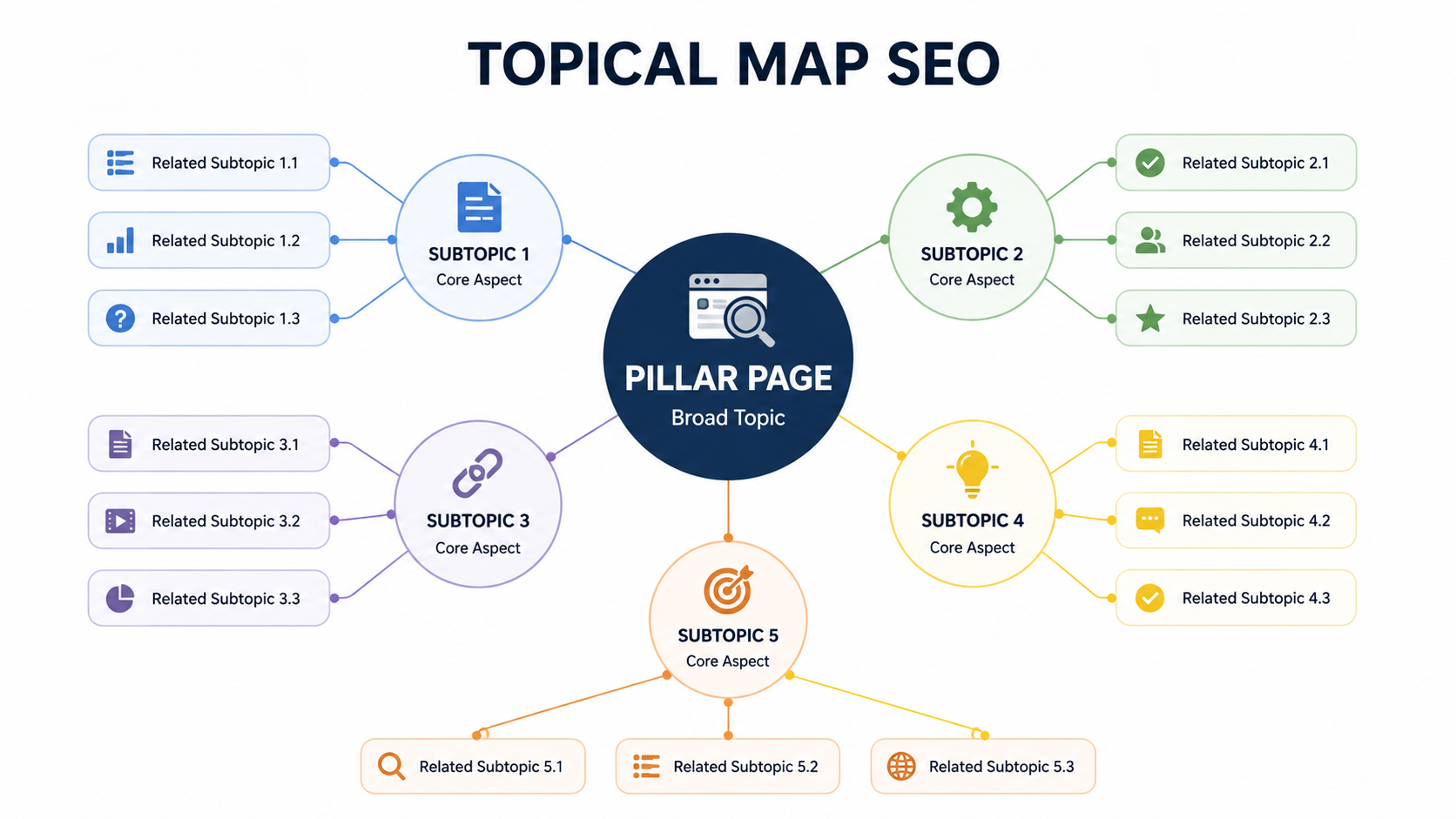
Understanding Topical Authority Through an Example
To better understand how topical authority works, consider the following comparison:
Website A
Publishes:
- One article about SEO
- One article about fitness
- One article about cryptocurrency
- One article about travel
- One article about real estate
Although Website A covers multiple topics, it lacks focus and depth. Search engines may struggle to determine a website’s specialization because there is no clear area of expertise.
Website B
Publishes:
- 100 SEO-focused articles
- Technical SEO guides
- Keyword research tutorials
- Link-building strategies
- SEO case studies
- Local SEO best practices
- On-page SEO optimization guides
- Google algorithm update analyses
- SEO tool reviews
- Search intent guides
- SEO FAQs
- Content marketing resources
- Internal linking strategies
- SEO reporting tutorials
Website B sends a much stronger signal to Google. Every piece of content contributes to a larger body of knowledge centered around SEO. The website covers beginner topics, advanced concepts, practical applications, industry trends, and common user questions.
As a result, Google is far more likely to recognize Website B as an authority on SEO because it demonstrates expertise across the entire topic ecosystem rather than merely touching on the subject occasionally.
Why Google Values Topical Authority?
Google’s primary goal is to provide users with the most helpful, accurate, and relevant information possible. To achieve this, its algorithms attempt to identify websites that consistently deliver high-quality content within specific areas of expertise.
When a user searches for SEO information, Google wants to recommend websites that have demonstrated a deep understanding of the topic. A website with extensive SEO content is generally more likely to provide valuable answers than a website that only has one or two SEO-related articles.
This is why topical authority has become increasingly important in modern SEO. Google’s algorithms are designed to reward websites that can answer not just one question, but hundreds of related questions within the same subject area.
For example, someone searching for “keyword research” may later search for:
- How to find low-competition keywords
- What is search intent?
- How to perform an SEO audit
- How to optimize title tags
- Best SEO tools
- Internal linking strategies
If your website contains comprehensive resources on all these topics, Google gains confidence in your expertise and is more likely to rank your content across the entire SEO category.
Topical Authority vs. Keyword Optimization
Many website owners still focus primarily on keyword optimization. While keywords remain important, they are only one piece of the puzzle.
Traditional SEO often followed this approach:
- Find a keyword.
- Create a page targeting that keyword.
- Build backlinks.
- Attempt to rank.
Modern SEO is different.
Today, search engines analyze the relationships between topics, entities, and concepts. Instead of simply asking whether a page contains a keyword, Google evaluates whether the website demonstrates expertise across the broader subject.
For instance, if you publish a single article targeting the keyword “how to build topical authority,” Google may see that article as useful. However, if your website also includes content about content clusters, semantic SEO, E-E-A-T, internal linking, keyword research, pillar pages, search intent, and content strategy, Google gains stronger evidence that your website genuinely understands the topic.
This broader understanding significantly improves your ranking.
The Relationship Between Topical Authority and Semantic SEO
Topical authority is closely connected to semantic SEO.
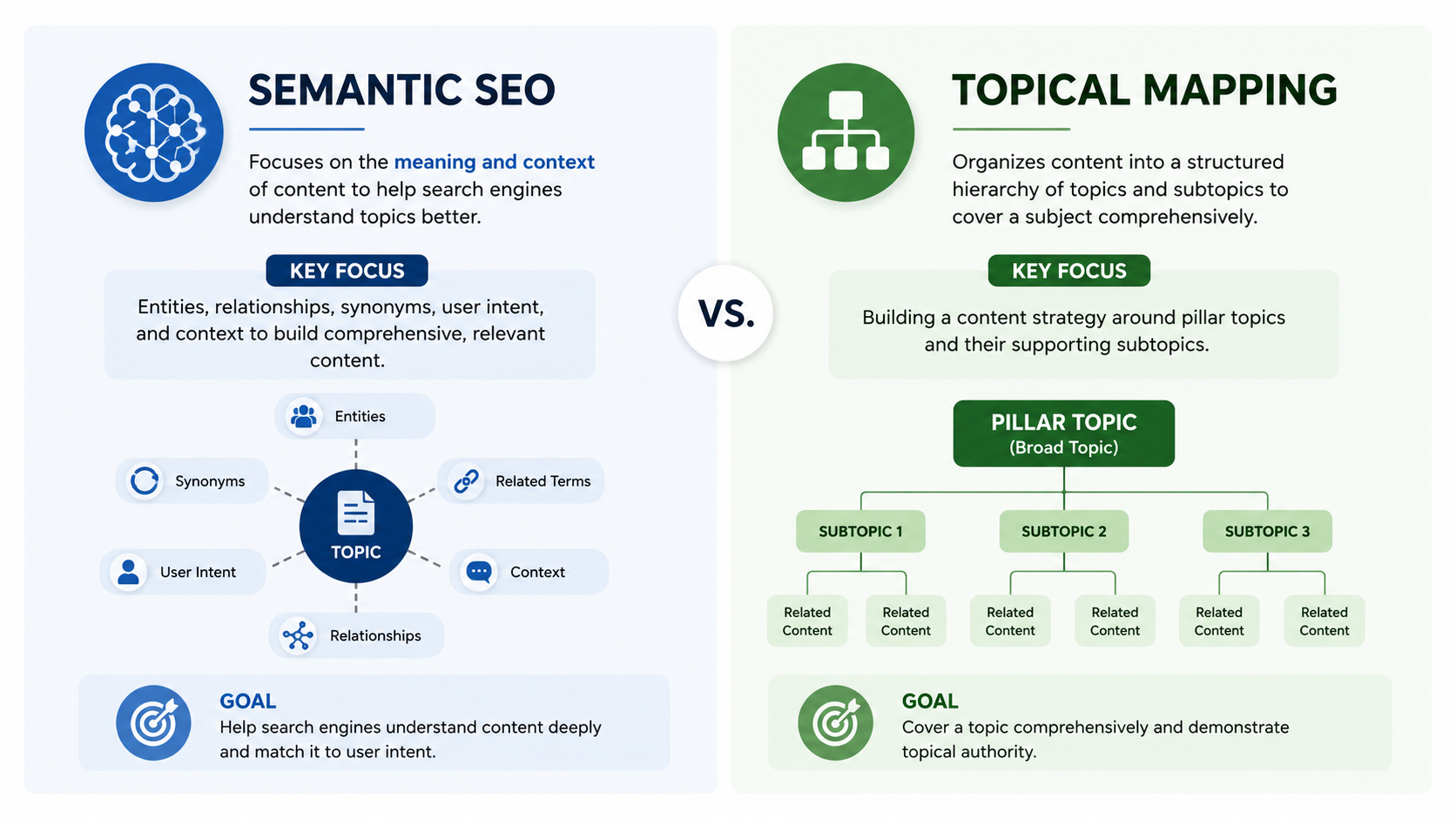
Semantic SEO focuses on helping search engines understand the meaning and context behind content rather than simply matching keywords.
For example, a comprehensive article about SEO may naturally discuss:
- Search engines
- SERPs
- Crawling
- Indexing
- Backlinks
- Metadata
- User intent
- Technical optimization
- Content quality
These related concepts help Google understand the content’s context and reinforce its relevance to the broader SEO topic.
As your website covers more interconnected concepts, it strengthens your topical authority and demonstrates a deeper understanding of the subject matter.
How Topical Authority Supports Google's E-E-A-T Guidelines?
Topical authority is also strongly connected to Google’s E-E-A-T framework, which stands for:
- Experience
- Expertise
- Authoritativeness
- Trustworthiness
These principles help Google evaluate content quality and determine whether users can rely on the information provided.
A website that consistently publishes detailed, accurate, and well-researched content naturally demonstrates expertise and authority. If the content is written by experienced professionals and supported by credible sources, it further strengthens trustworthiness.
This is particularly important for industries such as:
- Legal services
- Healthcare
- Finance
- Insurance
- Education
- Technology
In these industries, Google places an even greater emphasis on expertise and authority because inaccurate information can have serious consequences for users.
Topical Authority Is Built Over Time
One of the most important things to understand is that topical authority cannot be created overnight.
Many businesses publish a handful of blog posts and expect immediate SEO success. However, authority is earned through consistent effort and long-term content development.
Building topical authority requires:
- Thorough topic research
- Strategic content planning
- Comprehensive topic coverage
- Consistent publishing
- Strong internal linking
- High-quality user experiences
- Ongoing content updates
Over time, these efforts create a network of interconnected content that demonstrates expertise and helps search engines understand your niche specialization.
Why Topical Authority Matters in Modern Search?
Google’s mission is simple: provide users with the most relevant and trustworthy answers.
As search engines become smarter through artificial intelligence and machine learning, they increasingly evaluate websites based on expertise rather than isolated keyword targeting.
Modern SEO focuses on:
- User intent
- Context
- Relevance
- Expertise
- Authority
- Trustworthiness
This means websites can no longer rely solely on keyword optimization.
Instead, Google wants evidence that your website genuinely understands a subject and can provide comprehensive information.
This is why websites with strong topical authority often dominate search results.
When Google trusts your expertise, it becomes easier to rank new content because your site has already established credibility within that niche.
How Google Understands Topics and Expertise?
Google doesn’t simply analyze keywords anymore. It understands entities, relationships, concepts, and semantic connections.
For example, if your website discusses:
- SEO audits
- Keyword research
- Link building
- Search Console
- Core Web Vitals
- Content optimization
Google recognizes these concepts as closely related to SEO. As you cover more interconnected topics, Google gains confidence that your website genuinely understands the subject. This process helps establish topical authority.
Google evaluates several signals:
Content Breadth
How many relevant subtopics do you cover?
Content Depth
How thoroughly do you explain each subject?
Internal Connections
How well are your pages linked together?
User Satisfaction
Do visitors find your content useful?
External Validation
Do other reputable websites link to your content?
Together, these signals create a comprehensive picture of your expertise.
The Difference Between Domain Authority and Topical Authority
Many people confuse domain authority with topical authority. Although related, they are different concepts.
Domain Authority
Domain authority measures a website’s overall strength, largely based on its backlink profile and trust signals.
Example:
A major news website may have an extremely high domain authority.
Topical Authority
Topical authority measures expertise within a specific niche.
Example:
A niche SEO blog may have lower domain authority than a major news site, but it may have significantly higher topical authority in SEO.
In many cases, topical authority can outperform domain authority within specialized search results.
This is why smaller websites can outrank larger competitors when they focus deeply on a particular niche.
Benefits of Building Topical Authority
Understanding how to build topical authority delivers numerous advantages beyond rankings alone.
Higher Rankings Across More Keywords
Instead of ranking for one keyword, authoritative sites rank for hundreds of related searches.
Faster Indexing
Google often crawls and indexes trusted websites more quickly.
Increased Organic Traffic
More rankings lead to more visibility and traffic.
Improved User Trust
Users naturally trust websites that demonstrate expertise.
Better Conversion Rates
Visitors are more likely to become customers when they perceive authority.
Stronger Competitive Advantage
Authority creates a barrier that competitors struggle to overcome.
Long-Term SEO Stability
Topical authority tends to withstand algorithm changes better than short-term SEO tactics.
How to Build Topical Authority: A Step-by-Step Framework?
Now, Let’s discuss the practical process for building topical authority.
Step 1: Select Your Core Topic
Your first task is identifying the primary topic you want to own.
Examples include:
- Personal Injury Law
- Family Law
- Wildfire Recovery
- Digital Marketing
- Search Engine Optimization
- Roofing Services
- Home Renovation
- Financial Planning
Your topic should align directly with your products, services, and business goals.
Trying to become an authority on too many subjects simultaneously often leads to weak results.
Focus first.
Expand later.
Step 2: Identify Every Related Subtopic
Next, map out every question, concern, and subtopic associated with your niche.
For SEO, these may include:
- Technical SEO
- Local SEO
- E-commerce SEO
- SEO tools
- Content marketing
- Link building
- Keyword research
- Schema markup
- SEO reporting
The goal is comprehensive coverage. If users can search for it within your niche, it likely belongs in your content strategy.
Conducting Topic Research and Building a Topical Map
A topical map acts as your blueprint. Without one, your content strategy becomes scattered and ineffective.
What Is a Topical Map?
A topical map is a structured outline of all relevant content areas within your niche.
For example:
Main Topic:
SEO
Supporting Topics:
- Keyword Research
- Technical SEO
- On-Page SEO
- Off-Page SEO
- Local SEO
Subtopics:
- Keyword Difficulty
- Search Intent
- Canonical Tags
- XML Sitemaps
- Google Business Profile
This hierarchy creates a roadmap for content creation.
The more complete your topical map, the stronger your authority potential.
Creating Pillar Pages and Content Clusters
One of the most effective strategies for building topical authority involves content clusters.
What Is a Pillar Page?
A pillar page provides a broad overview of a topic.
Example:
“Complete Guide to SEO”
This page serves as the central hub.
What Are Cluster Pages?
Cluster pages dive deeply into individual subtopics.
Examples:
- Keyword Research Guide
- Technical SEO Checklist
- Link-building Strategies
- Local SEO Ranking Factors
- SEO Analytics Explained
Every cluster page links back to the pillar page. The pillar page links to cluster pages. This interconnected structure reinforces topical relevance.
Internal Linking and Semantic SEO
Internal links play a massive role in topical authority. Many websites underestimate their importance.
Google uses internal links to understand:
- Page relationships
- Topic hierarchy
- Content relevance
- Website structure

Internal Linking Best Practices
Link naturally between related content. Use descriptive anchor text.
Avoid generic phrases like:
- Click here
- Read more
Instead use:
- Technical SEO checklist
- Local SEO guide
- Keyword research strategy
These contextual signals strengthen topical relevance.
Semantic SEO Connection
Semantic SEO focuses on meaning rather than exact keyword matches.
Google understands related terms such as:
- SEO
- Search engine optimization
- Organic rankings
- SERPs
- Search visibility
Using semantically related concepts throughout your content helps reinforce expertise.
The Role of E-E-A-T in Topical Authority
Google’s E-E-A-T framework stands for:
Experience
Have you personally experienced the topic?
Expertise
Do you possess relevant knowledge?
Authoritativeness
Do others recognize your authority?
Trustworthiness
Can users trust your information?
Strong topical authority requires strong E-E-A-T.
Ways to improve E-E-A-T include:
- Detailed author bios
- Professional credentials
- Case studies
- Original research
- Customer testimonials
- Expert interviews
Google increasingly values content created by real experts with demonstrated experience.
Content Quality and User Intent
Creating content isn’t enough. It must satisfy user intent.
Search intent typically falls into four categories:
Informational
Users seek information.
Example:
“What is topical authority?”
Navigational
Users seek a specific website.
Example:
“Excell SEO services”
Commercial
Users compare options.
Example:
“Best SEO agencies”
Transactional
Users intend to purchase.
Example:
“Hire an SEO consultant”
A strong topical authority strategy creates content for all stages of the buyer journey.
Building Backlinks That Support Topical Authority
Backlinks remain essential. However, relevance matters more than ever. A backlink from a highly relevant website often provides more value than dozens of unrelated links.
Effective Link-Building Strategies
Guest Posting
Contribute valuable content to industry websites.
Digital PR
Earn media coverage through expert insights.
Original Research
Publish unique data studies.
Resource Pages
Get included in curated industry resources.
Expert Roundups
Participate in collaborative content opportunities.
The goal is earning links that reinforce your expertise.
Measuring Your Topical Authority Progress
Building authority takes time. Tracking progress helps maintain momentum.
Key metrics include:
Organic Traffic
Monitor growth from search engines.
Ranking Keywords
Track the number of keywords ranking.
Top 10 Rankings
Measure high-visibility positions.
Backlink Growth
Monitor authority signals.
User Engagement
Analyze:
- Time on page
- Bounce rate
- Pages per session
Conversion Rates
Ultimately, rankings should contribute to business goals.
Common Mistakes to Avoid
Many businesses struggle because they make predictable mistakes.
Publishing Random Content
Every article should support your topical map.
Ignoring Search Intent
Content must match user expectations.
Creating Thin Articles
Comprehensive content generally performs better.
Poor Internal Linking
Disconnected content weakens authority.
Inconsistent Publishing
Authority requires ongoing investment.
Neglecting Content Updates
Fresh content remains more competitive.
Frequently Asked Questions About How to Build Topical Authority
1. How long does it take to build topical authority?
Most websites begin seeing meaningful improvements within six to twelve months, depending on competition, content quality, and backlink acquisition.
2. How many articles are needed to establish topical authority?
There is no universal number. Some niches may require 30 high-quality articles, while competitive industries may require hundreds.
3. Is topical authority more important than backlinks?
Neither is more important. Topical authority and backlinks work together to strengthen rankings and credibility.
4. Can a new website build topical authority?
Yes. In fact, focusing on topical authority is one of the most effective ways for new websites to compete against larger brands.
5. What is the biggest factor in building topical authority?
Comprehensive topic coverage combined with high-quality content and strategic internal linking is often the most important foundation.
Final Thoughts
As Google’s algorithms continue evolving, the importance of topical authority will only increase. Search engines no longer reward websites simply for targeting individual keywords. Instead, they reward websites that consistently demonstrate expertise, answer user questions comprehensively, and provide trustworthy information across an entire subject area.
Learning how to build topical authority is not about shortcuts or quick wins. It requires careful planning, consistent content creation, strategic internal linking, strong E-E-A-T signals, and a commitment to serving your audience better than competitors.
The payoff, however, is enormous. Websites with strong topical authority enjoy higher rankings, increased traffic, greater trust, stronger lead generation, and long-term SEO stability.
If your goal is sustainable organic search growth, building topical authority should be at the center of your SEO strategy.
Ready to Build Topical Authority and Dominate Your Industry?
At Excell, we help businesses transform their websites into trusted industry leaders through advanced SEO strategies, content marketing, technical optimization, and proven topical authority frameworks.
Our team doesn’t just help you rank for a few keywords; we help you build a complete content ecosystem that earns Google’s trust, attracts qualified traffic, and generates measurable business growth.

Whether you’re looking to increase leads, improve search visibility, outperform competitors, or establish your brand as the go-to authority in your niche, Excell has the expertise and proven methodology to make it happen.
Stop chasing rankings and start building authority. Contact us today and Book your free discovery call to get done for your services. The sooner you start building topical authority, the sooner you’ll start owning your market.
Contact us:
EXCELL INDUSTRIES LLC
6420 Richmond Ave., Ste 470
Houston, TX, USA
Phone: +1 832-850-4292
Email: info@excellofficial.com