


Inbound vs Outbound Leads: For companies looking to build a predictable sales pipeline, increase marketing efficiency, and achieve long-term success, understanding inbound vs outbound leads is critical. Inbound leads are prospects who find your content, website, search listings, social media, or other marketing resources. Outbound leads are generated when your company takes the initiative to contact potential customers via cold calling, email prospecting, paid campaigns, direct sales outreach, and so on.
Table of Contents:
- What is an inbound lead?
- What Are Outbound Leads?
- Inbound and Outbound Leads: What’s the Difference?
- What is inbound lead generation?
- How Does Outbound Lead Generation Process Work?
- Benefits of Inbound Leads
- Why Outbound Leads Are Better?
- The Challenges of Each Approach
- Which Leads Are Most Likely to Purchase?
- Inbound vs Outbound Lead Costs
- How to Blend Inbound and Outbound Marketing?
- Which strategy is more growth-impelling?
- Inbound versus outbound lead measurement
- Increase the Quality of Your Inbound Leads
- Improve the Quality of Your Outbound Leads
- Inbound vs Outbound Leads: Frequently Asked Questions
- Inbound versus Outbound Leads: Finding the Right Balance
- Excell: Scale Your Lead Generation Strategy
Lead generation is one of the most crucial tasks of every marketing and sales firm. Without a steady stream of qualified prospects, even a great product or service firm can have trouble growing revenue. However, leads are not all created the same manner.
Some prospects discover a business when they are searching for information or solutions. Others are introduced to a company because a salesperson, advertisement, or direct marketing campaign gets to them.
These two tactics are the foundation of the inbound vs. outbound leads debate.
You shouldn’t automatically consider either one superior in every situation. Depending on your industry, client acquisition costs, sales cycle, target audience, marketing resources, and growth goals, this approach will be more or less effective.
Understanding the difference between the two approaches will help your organization decide where to spend your marketing dollars and how to build a better customer acquisition strategy.
1. What is an inbound lead?
Inbound leads are potential customers who discover your brand and contact your business through marketing content or some other attraction-based route.
They come to you, not you to them. Your inbound lead may arrive at your organization via:
- Google Search Results
- Blog Posts
- Search engine optimization
- Social networkings
- Videos
- Internet Guide
- Email newsletters and Email programs
- Webinar
- podcasts
- Referrals
- Organic traffic on the website
- Download Resources
- Case Histories
Let’s say someone is going to Google and searching for how to improve their digital marketing plan for their organization.
They see an informative article from your company, read many pages on your website, and finally fill out a consultation form.
That person becomes an inbound lead. They were on a quest for information when their adventure began, not because your sales department reached out to them.
That’s one of the greatest distinctions when you compare inbound vs. outbound leads.
Inbound marketing aims to attract potential customers by being present when they’re investigating their problems, needs, or alternatives.
2. What Are Outbound Leads?
Outbound leads are leads that a company generates by reaching out to potential customers.
The company doesn’t wait for someone to find the organization; they go out and find people or businesses that would be a suitable fit and start conversations.
Common outbound lead generation tactics are:
- Cold-calling
- Cold Email Campaigns
- Mail (direct)
- LinkedIn prospecting
- Sales Development Reps
- Trade fair
- Advertising (paid)
- Banner advertising
- Sponsored posts
- Account-based marketing
- Networking events
- Direct outreach for sales
Take a software company that sells project-management solutions to construction firms.
Its sales team may build a list of construction companies that meet its ideal customer profile. Then, the sales reps reach out to decision-makers in those companies by email, phone, or LinkedIn.
The prospects had not been actively seeking the software prior to this outreach.
No, the firm started the relationship. That’s outbound lead generation.
3. Inbound and Outbound Leads: What’s the Difference?
The main difference between inbound and outbound leads is who initiates the conversation.

Inbound marketing is when the prospect finds the company and contacts the company.
Outbound marketing is when the business goes out to the prospect.
A simple analogy would be
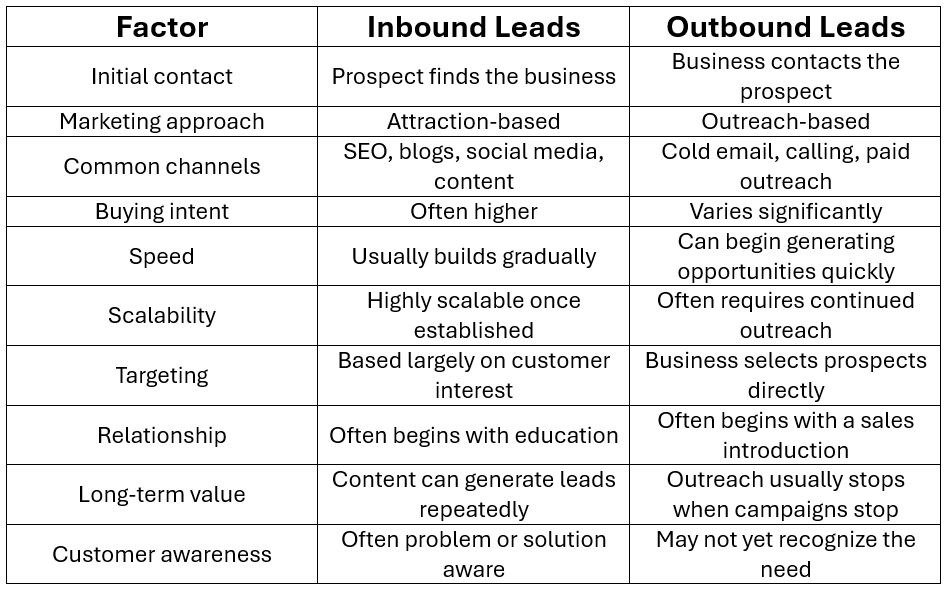
Both ways can provide revenue. The question is not simply whether your organisation should do inbound or outbound marketing.
A better question: how can each strategy add to the customer journey?
4. What is inbound lead generation?
Inbound lead generation refers to the creation of marketing assets that prospects can find when they’re looking for solutions to their needs.
This is normally a multi-step process.
Gain Potential Customers
The first step is to reach potential customers. Common attraction tactics include:
- SEO (Search Engine Optimisation)
- Content of blog post
- Videos
- Social media marketing
- Learning Guides
- Industry sources
- Thought Leaders
- Local SEO
SEO is really crucial.
When potential buyers Google enquiries about your business, well-optimised content can bring your brand to their attention before they ever talk to a salesperson.
Audience Awareness
Inbound marketing is rarely about asking visitors to buy right away.
Instead, leading companies teach their potential customers about their problems and offer solutions. The educational content may be:
- Articles on How to
- Comparison guides
- How-to’s
- To-Do Lists
- Case study
- Business news
- Frequently Asked Questions
This strategy helps you to build your organization’s reputation by providing useful information.
Turn Visitors Into Leads
You have to have a reason for someone to give you their contact info .
Typical points of conversion are:
- Kinds of contact
- Requests for consultation
- Subscribe to the newsletter.
- Request a Quote
- Sign up for a webinar.
- Reserve a Demo
- Resources to download
Once visitors provide their information, they become recognizable prospects.
Maintain the Relationship
Not each inbound lead is ready to buy right now.
When you use email marketing, retargeting, additional instructional content, and sales follow-ups, you may get prospects closer to the point of decision.
This method creates a marketing funnel that can turn website visitors into leads.
5. How Does Outbound Lead Generation Process Work?
Outbound marketing takes the opposite tack. Instead of waiting for prospects to convert, businesses actively seek potential customers.
Identify Your Target Audience
The heart of any successful outbound effort is targeting.
Businesses should know exactly what traits are:
- Industry
- Company size
- Room
- Position
- Revenues
- Business challenges
- Purchasing power
- Demographics of customers
A specific ideal customer profile stops sales teams from wasting time reaching out to people who don’t fit the description.
Build Your Prospect List
Companies then select particular prospects that are inside their target audience.
For B2B companies, this process might mean companies and decision-makers in specific industries.
B2C firms might target customers using demographic, regional, or behavioral information.
Start Direct Outreach
Sales and marketing teams can touch prospects through channels like:
- Telephone
- ADVERTISEMENT
- Networking
- Mailing
- Industry events
The aim is to raise awareness and open a dialogue.
Identify Potential Customers
Some of the people you contact will decline.
Sales teams so establish whether prospects have:
- A requirement of relevance
- Purchase authority
- Enough funds
- A proper timetable
- A true interest in the solution
Qualified leads can then move through the sales process.
6. Benefits of Inbound Leads
There are several major benefits to inbound marketing.
Existing Interest Higher
Many inbound prospects are already searching for information about your product or service.
This implies that the business does not necessarily need to argue that there is a problem. Instead, marketing can focus on showing why your organization might be a good fit.
Long-Term Lead Generation
The great thing about inbound marketing is that it can keep producing results.
For example, a well-optimized post could rank in search results and attract potential clients for months or even years.
The corporation produces the material just once, but it can attract visitors hundreds of times over the years.
Boosts brand authority.
A business can earn a reputation as a reliable source of information by regularly publishing useful content.
Potential clients might read several articles, view videos, subscribe to a newsletter, or follow a brand before they reach out to the company.
“Each encounter builds familiarity and trust.”
Boosts organic search growth

Inbound marketing and SEO often go hand in hand.
Every quality article can also target more keywords, which increases the number of ways your clients can find your business. Eventually your website might have a considerable organic presence.
Even More Scalability
A salesperson has only a restricted amount of calls each day.
In contrast, a blog entry can be viewed by thousands of potential buyers at the same time. This makes inbound marketing effective and very scalable.
7. Why Outbound Leads Are Better?
Outbound marketing does have its benefits too, especially for businesses that need to target a specific audience directly.
Rapid Market Penetration
SEO and content marketing can take time to generate organic traffic.
You can begin outbound marketing today. Today’s sales departments can find new prospects and begin reaching out to them almost immediately.
Accurate Targeting
With outbound sales, firms can control exactly who they are communicating with.
For example, a company offering enterprise software may aim to reach out to:
- Chief information officers
- Operations Manager(s) jobs
- Companies with more than 500 workers
- Businesses in particular industrie
Outbound prospecting allows you to directly control your target audience.
Useful to New Businesses
When new companies start out, they have little brand awareness and website traffic.
And waiting for an inbound strategy to evolve may not produce enough opportunities in the early stage of a company’s growth.
Outbound advertising can help start the initial sales conversation while you are building inbound marketing.
Best for B2B High-Value Sales
A firm that sells pricey or complex products may have only a few prospective clients.
In these cases, highly targeted marketing might sometimes be more practical than establishing a big audience.
8. The Challenges of Each Approach
When comparing inbound vs outbound leads, it’s equally crucial to know the weaknesses of both tactics.
Inbound Marketing Challenges
Inbound marketing is usually a slow game. It takes some time for a new website to rank for competitive search queries.
Businesses need to keep producing valuable content and optimising their sites until they see a significant organic presence.
Other incoming issues include:
- High-content competition
- SEO difficulty
- Changes to the algorithm
- Production costs of content
- Development times are long.
- Competitive Keyword Difficulty Ranking
Inbound marketing can work really well, but it’s often better to view it as a long-term growth strategy, not an instant source of leads.
Problems With Outbound Marketing
Outbound marketing has another difficulty. Interruption.
Potential buyers might not be looking for what the company sells. Sales teams have to get their attention and convince them to engage.
Common problems include:
- Low reaction rate
- Cold call resistance
- Email filtering
- Quality issues list
- Sales: labour expense
- Advertising costs
- Fatigue of prospects
Outbound marketing also requires regular activity.
Leads from such sources can quickly dry up when a business stops cold calling or advertising.
9. Which Leads Are Most Likely to Purchase?
Inbound leads also tend to have a high desire to buy. Many have already made some action that signals interest.
For example, a person who is looking for a particular service, visits a company website, checks on price information and sends a request for a consultation has provided multiple signals that they may be intending to purchase.
But not every inbound lead is a qualified lead. Visitors could be simply gathering information.
Some may not have the resources, authority or urgency to be clients.Even outbound leads might be quite qualified when the targeting is on point.
For example, a business that uses account-based marketing may find a handful of accounts that align exactly with its ideal customer profile.
Those prospects haven’t been proactive in reaching out, but they could be great chances.
Thus, lead quality should be evaluated by parameters such as:
- Want
- Purpose
- Budget
- Power
- Scheduling.
- Suitable for customers
Where a lead comes from does not define its quality.
10. Inbound vs Outbound Lead Costs
Cost is another big aspect when comparing inbound versus outbound leads.
Inbound Expenses
The costs of inbound marketing may include:
- SEO strategy
- Writing content
- Developing websites
- Graphic Design
- Video Production
- Email marketing software:
- Marketing Automation (MA)
- Platform Analytics
It can require a large initial outlay.
But content that performs well can continue to generate traffic long after it is published.
A higher level of organic know how can also help to reduce the average cost of acquisition of each additional lead.
Outbound charges
Outbound expenses may include:
- Salaries – Sales
- Prospecting tools
- Paid-for databases
- Advertisement
- List of leads
- CRM systems
- Upcoming Events
- Direct mail
- Email outreach programmes generate leads.
A lot of outbound initiatives need to be continually funded to keep the amount of leads coming in.
So, for instance, when you stop paying for ads, the traffic those ads were generating would normally stop as well.
So, calculating spending is not enough to make a proper comparison of expenses.
Businesses should be measuring:
Cost per qualifying lead
and
Customer acquisition costs.
A low-cost marketing channel may still not perform well if those leads don’t convert into paying clients.
11. How to Blend Inbound and Outbound Marketing?
For many firms it can be useful to use a combination of the two approaches rather than a straight inbound versus outbound option.
Inbound marketing can generate recognition and credibility, while outbound sales can directly expose the company to strategically essential prospects.
Take this example. A corporation provides a large library of industry material with the intention of ranking on Google. At the same time, its sales team reaches out to high-value enterprises with tailored outbound efforts.
A prospect may look up the company on Google when a sales representative gets in touch with them. They find:
- Useful articles
- Case studies
- Reviews
- Research industry
- Service pages
- Video
The inbound material feeds the outward sales effort.
The reverse is also true. Outbound discussions can expose prospects’ frequently asked queries. Marketing teams can use these questions to generate SEO content that attracts future inbound leads.
The best tactics build this feedback loop between marketing and sales.
12. Which strategy is more growth-impelling?
It is contingent upon the type of expansion the business needs. Inbound marketing works particularly well for establishing sustainable long-term demand.
A valuable new page on a website can enhance a company’s digital presence.
An ever-growing library of optimised content can generate:

- Organic traffic
- Knowledge of brand
- Leads
- Subscribe by Email
- Sales Leads
Outbound marketing may be more effective if your organisation wants to immediately generate sales prospects or target a very specific group of potential clients.
For instance, a new B2B firm may not have the luxury of waiting several months for its content marketing to grow.
Outbound sales can open conversations as organic exposure builds.
So frequently growth is about the perfect balance.
Maybe one pragmatic solution would be:
Outbound campaigns for short-term growth
Paid campaigns + building inbound channels for medium-term growth.
Long-term growth: SEO, content, brand authority and client retention with a focus on outbound heavy.
When correctly coordinated, both strategies complement each other.
13. Inbound versus outbound lead measurement
And companies shouldn’t be measuring success by sheer lead volume. 1,000 leads are worthless if hardly any of those leads turn into clients. Instead, marketers should be tracking analytics all the way down the funnel.
Inbound Marketing KPIs
Useful metrics are:
- Natural Website Traffic
- Search ranking
- Conversion rates
- Marketing qualified leads
- Cost per lead
- Landing page conversion
- email mailing list
- Cost of acquiring customers
- Organic Search Revenue
Outbound Marketing Measurement
Key outgoing metrics include:
- Completed calls
- Sent emails
- Response rates
- Meetings planned
- Qualified opportunities.
- Sales conversion rate
- Cost of acquiring customers
- Revenue per Campaign
Lead Volume Is Less Important Than Revenue
The end game of lead generation isn’t only to get contact information.
Business needs customers. A channel that provides fewer leads but highly qualified leads may earn much higher income than a channel that generates many weak leads.
Thus, marketing and sales teams must consider the full customer journey.
14. Increase the Quality of Your Inbound Leads
More visitors to your website doesn’t necessarily mean higher leads. Inbound campaigns should target themes that are closely related to client demands.
Search Intent Focus
Search intent is what a person is looking for when they send a query to a search engine.
Some searches are for information:
What does CRM software mean?
Others have a higher purchase intent:
“Best CRM software for small businesses”
And some are very commercial:
Price of CRM software
Target a mix of informational and commercially relevant keywords to bring prospects at many points of the purchase experience.
Develop Strong Service Pages
Blog posts often get the most attention, while service or product pages typically have the biggest impact on conversions.
These pages should make clear:
- What the company does
- Who is the solution for
- Problems it solves
- Advantages
- Characteristics
- Pricing information where relevant
- Customer Success
- What next?
Use strong calls to action.
Don’t keep visitors guessing as to what to do next.
Good CTAs might inspire visitors to:

- Request a consultation.
- Get a Quote
- Try it out for free.
- Book a demo.
- Download a guide on:
- Please ring the company.
Your conversion channels should be clear, so qualified visitors are more likely to convert to leads.
15. Improve the Quality of Your Outbound Leads
Targeting is so much better, so outbound campaigns are much better.
Developing an Ideal Customer Profile
Look at your current high value customers.
Search for common qualities, such as:
- industry
- Size of Organization
- Sales (continued)
- web site
- Customer’s requirement
- Consumer behavior
This information can help sales teams target their outreach.
Personalise the Communication
Generic sales pitches are falling on deaf ears.
The more you understand about their business or specific difficulties, the more likely prospects are to respond. Personalisation is more than just putting someone’s first name in an email.
The message should indicate the connection to the discussion.
Coordinate marketing and sales efforts
Marketing teams can give beneficial materials for sales reps, such as:
- Case Study
- Manuels
- Articles
- Research
- Testimonials
- Comparison pages
Sales reps can provide these resources in the conversation.
This is inbound and outbound marketing at work again.
16.Frequently Asked Questions
1. Is inbound or outbound lead generation more effective?
Neither strategy is universally more effective. Inbound lead generation can support long-term organic growth, while outbound lead generation can help businesses reach specific prospects and create sales opportunities more quickly.
2. Are inbound leads more qualified than outbound leads?
Inbound leads may show stronger buying intent because they are actively searching for information or solutions. However, outbound leads can also be highly qualified when businesses target prospects that closely match their ideal customer profile.
3. Is inbound lead generation cheaper than outbound lead generation?
The cost depends on the industry, audience, competition, and marketing resources available. Inbound marketing can continue generating leads from existing content, while outbound marketing often requires ongoing spending on sales efforts, advertising, prospecting tools, or databases.
4. What are the benefits of inbound lead generation?
Inbound lead generation can increase organic visibility, build brand authority, attract prospects who are already researching solutions, and create long-term lead generation opportunities through SEO and content marketing.
5. What are the benefits of outbound lead generation?
Outbound lead generation allows businesses to target specific prospects, start conversations quickly, reach new markets, and create opportunities even when the company has limited organic traffic or brand awareness.
17. Inbound versus Outbound Leads: Finding The Right Balance
The inbound vs outbound leads issue shouldn’t leave organisations choosing between one method or the other.
They each handle a distinct consumer acquisition problem. Inbound marketing makes your business discoverable. Outbound marketing helps your business go after opportunities.
Inbound methods are powerful because they can deliver the compounding visibility. SEO pages, educational content, videos, case studies and other digital resources can continue to draw prospects long after they are published.
Outbound gives you control and velocity. Businesses may find potential consumers that will be useful and reach out to them instead of waiting for them to find you.
Both can be used by firms seeking sustainable expansion as part of a bigger customer-acquisition scheme.
Outbound activities can generate short-term opportunities.
Inbound marketing can reduce the need for ongoing prospecting by creating a steady stream of people who come to the company naturally.
The point is the measurement. Keep track of where your leads are coming from, how fast they’re moving through your funnel, how much it costs to get them and how much revenue they ultimately generate.
This way your organization can make more confident investments into the channels that provide a significant business value.
18. Excell: Scale Your Lead Generation Strategy
Getting leads is the beginning.Sustainable development is about getting the right leads at the right time and turning their curiosity into real, measurable revenue.
At Excell, we help businesses to build a stronger digital presence with strategies that increase exposure, attract qualified leads and generate additional possibilities to develop. From SEO and content marketing to a full digital strategy, we specialise in helping your business reach the people who are already looking for what you offer.

If you want to create more inbound leads, strengthen your outbound marketing activities, increase your visibility in search or develop a customer acquisition plan that can support long-term growth, Excell can help you go forward with a clearer strategy.
Stop depending on unreliable lead generation. Build a marketing engine that pulls in, connects with and turns into customers the people your business needs. Contact us today and Book your free discovery call to get done for your services.
Contact us:
EXCELL INDUSTRIES LLC
6420 Richmond Ave., Ste 470
Houston, TX, USA
Phone: +1 832-850-4292
Email: info@excellofficial.com