

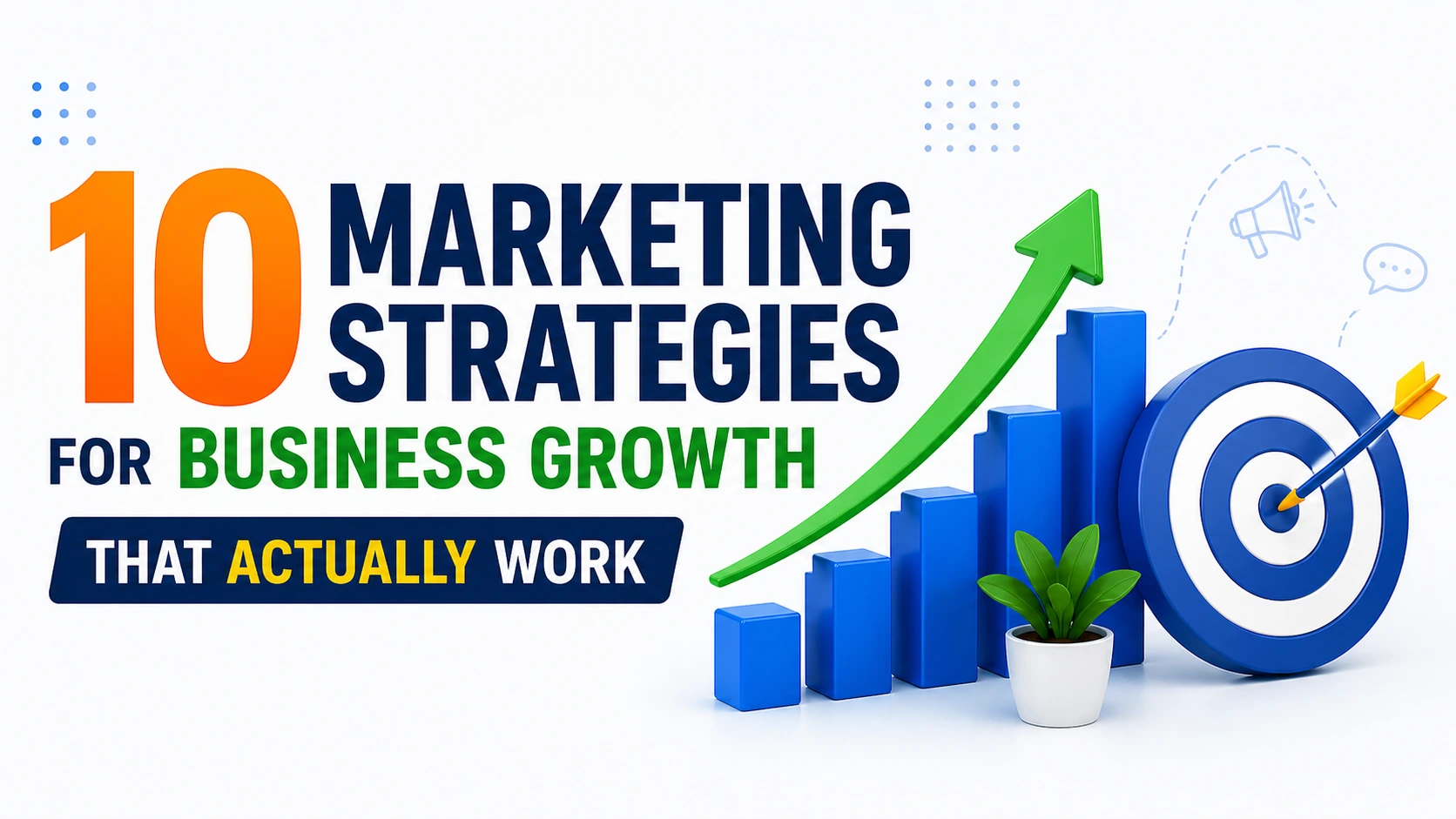

Today’s digital world is more competitive than ever, so businesses can’t depend on old methods or guesswork to grow. Success comes from using proven, planned, and flexible marketing strategies. Whether you’re just starting out or looking to expand, the right approach can help you reach more people, boost engagement, and increase revenue.
This guide offers more than basic tips. It provides practical advice, real examples, and clear steps you can use to get real results from your marketing.
Table of Contents:
- Introduction to Marketing Strategies for Business Growth
- Why Marketing Strategy Matters More Than Ever?
- Strategy #1: Build a Strong Brand Identity
- Strategy #2: Invest in SEO and Content Marketing
- Strategy #3: Leverage Social Media Marketing
- Strategy #4: Use Paid Advertising Strategically
- Strategy #5: Email Marketing for Retention and Growth
- Strategy #6: Influencer and Partnership Marketing
- Strategy #7: Data-Driven Decision Making
- Strategy #8: Optimize Conversion Funnels
- Strategy #9: Customer Experience as a Growth Tool
- Strategy #10: Marketing Automation and AI
- Common Mistakes to Avoid
- Frequently Asked Questions
- Conclusion and Call to Action
Introduction to Marketing Strategies for Business Growth
Marketing is about sharing value with the right people. Just having an online presence isn’t enough anymore. Businesses need to be clear about how they present themselves, how they share their message, and how they help customers through the buying process.
Effective Marketing Strategies for Business Growth act as a blueprint. They help businesses:
- Identify their ideal audience.
- Deliver relevant messaging
- Choose the right channels.
- Measure and improve performance
Why Marketing Strategy Matters More Than Ever?
Having clear marketing strategies is more important now than ever. As technology and consumer habits change, people find and buy products in new ways. If businesses don’t keep up, they risk getting lost in the crowd.
Consumers today don’t just see ads—they take an active role in buying. They research, compare, read reviews, and interact with brands on different platforms before deciding. Because of this, marketing is about guiding people from first learning about you to becoming customers.

The Reality of Today’s Market
- Consumers Research Before Buying
Before making a purchase, customers often conduct extensive research. They read blog posts, watch videos, compare competitors, and check reviews. This means your business must be visible and credible at every stage of the decision-making process. If your content or presence is lacking, you risk losing potential customers before they even consider your offer. - Trust Is Built Over Multiple Touchpoints
Most customers don’t buy after just one interaction. Trust builds over time as people see your social posts, emails, website, or reviews. A good marketing strategy makes sure every contact supports your brand and builds trust. - Competition Exists in Every Niche
No matter your industry, you are competing not only with direct competitors but also with alternative solutions and substitutes. Digital platforms have lowered barriers to entry, allowing new competitors to emerge quickly. Without clear Marketing Strategies for Business Growth, it becomes difficult to differentiate your brand and maintain a competitive edge. - Information Overload Is the New Normal
People see ads, emails, videos, and social posts all day. To get noticed, your marketing needs to be focused and relevant. Generic messages are ignored, but targeted, personal content gets attention.
What a Strong Strategy Provides
1. Direction: You Know Where to Focus Your Resources
- Who your target audience is
- Which channels to prioritize
- What messaging resonates most
2. Efficiency: You Eliminate Wasted Efforts
- Identifying high-performing channels
- Eliminating underperforming tactics
- Streamlining workflows
3. Scalability: You Can Grow What Works
A big benefit of strong marketing strategies is that they can grow with your business. When you find something that works, like a good ad or blog post, you can repeat and build on it.
For example:
- A successful Facebook ad can be scaled with a larger budget.
- A top-ranking blog post can be updated and expanded.
- A converting funnel can be applied to new products.
4. Consistency: Your Messaging Stays Aligned
Consistency is critical in building brand recognition and trust. A clear strategy ensures that your messaging, tone, and visuals remain aligned across all channels.
This consistency:
- Reinforces your brand identity
- Builds familiarity with your audience
- Strengthens customer trust over time
The Strategic Advantage in a Competitive Landscape
Businesses that focus on strategy have a real edge over those that just react or follow trends.
Instead of chasing what’s popular, they:
- Make data-driven decisions
- Focus on long-term growth.
- Build sustainable systems
The Role of Integration in Modern Marketing
Another reason strategy is important is that everything needs to work together. The best marketing strategies connect different parts instead of keeping them separate.
For example:
- SEO drives traffic to your website
- Content marketing educates and nurtures visitors.
- Email marketing converts leads into customers.
- Social media reinforces engagement and brand awareness.
Adapting to Constant Change
Marketing is always changing. Algorithms update, new platforms appear, and customer preferences shift. A strong strategy stays flexible and can adapt.
Businesses with a strategic foundation can:
- Quickly adjust to new trends.
- Test and optimize campaigns
- Stay ahead of competitors.
Strategy #1: Build a Strong Brand Identity

- Visual Identity: Logo, colors, typography
- Brand Voice: Friendly, authoritative, or playful tone
- Positioning: What makes you different
- Story: Why your business exists
Deeper Insight:
Action Steps:
- Define your unique value proposition (UVP)
- Create consistent visuals across all platforms.
- Develop a brand messaging framework.
Strategy #2: Invest in SEO and Content Marketing
- It generates consistent organic traffic.
- It builds credibility over time.
Content Marketing’s Role:
Types of Content:
- Blog articles
- How-to guides
- Videos and webinars
- Infographics
- Case studies
Advanced SEO Insights:
- Use keyword clusters (not just one keyword)
- Optimize for user intent, not just rankings.
- Build topical authority
Example:
Long-Term Impact:
Strategy #3: Leverage Social Media Marketing
Why It Works:
- Real-time engagement
- Direct communication
- Brand personality expression
Content Types:
- Educational posts
- Behind-the-scenes content
- User-generated content
- Live videos
Consistency Formula:
- Post regularly
- Respond to comments
- Encourage interaction
Strategy #4: Use Paid Advertising Strategically
When to Use Paid Ads:
- Launching a new product
- Testing offers
- Scaling successful campaigns
Key Platforms:

- Google Ads (search-based intent)
- Facebook/Instagram Ads (interest-based targeting)
- YouTube Ads (video engagement)
- Use retargeting campaigns
- A/B test ad creatives
- Optimize for conversions, not clicks.
Strategy #5: Email Marketing for Retention and Growth
Why Email Works:
- You own your audience (no algorithm dependency)
- Highly personalized communication
- Strong conversion rates
- Welcome series
- Promotional emails
- Educational newsletters
- Customer retention campaigns
- Behavioral segmentation
- Automated workflows
- Personalized recommendations
Strategy #6: Influencer and Partnership Marketing
Why It Works:
- Social proof increases credibility.
- Faster audience reach
- Authentic recommendations
- Sponsored content
- Affiliate partnerships
- Co-branded campaigns
This approach speeds up your growth by connecting you with communities that already trust your partners.
Strategy #7: Data-Driven Decision Making
What to Track:
- Website traffic
- Conversion rates
- Customer behavior
- Campaign performance
- Google Analytics
- CRM platforms
- Marketing dashboards
Key Principle:
Strategy #8: Optimize Conversion Funnels
Funnel Breakdown:
- Awareness
- Interest
- Consideration
- Conversion
- Clear messaging
- Strong CTAs
- Minimal distractions
- Trust signals
A simple improvement, such as changing a button color or headline, can significantly increase conversions.
This is one of the most overlooked Marketing Strategies for Business Growth, yet it delivers immediate impact.
Strategy #9: Customer Experience as a Growth Tool

- Happy customers return
- Satisfied customers refer others.
- Loyal customers spend more.
- Website usability
- Customer support
- Post-purchase experience
Strategy #10: Marketing Automation and AI
Benefits:
- Saves time
- Improves consistency
- Enhances personalization
- Automated email sequences
- Chatbots
- AI-powered recommendations
Common Mistakes to Avoid
Even the most well-planned marketing strategies can fail if they aren’t properly implemented. Having a plan isn’t enough—success comes from following through, staying consistent, and always improving.
Many businesses struggle not because their ideas are bad, but because they make common mistakes that slow growth. void them—can make the difference between stagnation and sustainable success.
• Lack of Consistency
Why This Happens:
- Lack of a clear content or campaign schedule
- Limited resources or time
- Unrealistic expectations for quick results
Marketing is cumulative. Results often come after repeated exposure, not one-time efforts.
When your messaging, posting frequency, or branding is inconsistent, it:
- Confuses your audience
- Weakens brand recognition
- Reduces trust and credibility
How to Fix It:
- Create a content calendar.
- Set realistic posting schedules.
- Use automation tools to maintain consistency.
- Focus on long-term commitment rather than short bursts.
• Ignoring Data
The Problem:
- Decisions based on guesswork
- Failure to track key performance indicators (KPIs)
- Ignoring insights from analytics tools
- What’s working
- What’s underperforming
- Where to allocate resources
Key Metrics to Track:
- Website traffic and sources
- Conversion rates
- Click-through rates (CTR)
- Customer acquisition cost (CAC)
- Return on investment (ROI)
- Use tools like Google Analytics, CRM systems, and ad dashboards.
- Regularly review performance reports.
- Make data-driven adjustments to campaigns.
• Targeting the Wrong Audience
Why This Happens:
- Lack of clear customer personas
- Misunderstanding customer needs
- Broad or generic targeting
- Low engagement rates
- Poor conversion performance
- Wasted marketing budget
How to Fix It:
- Define your ideal customer profile (ICP)
- Segment your audience based on behavior and demographics.
- Tailor messaging to specific audience needs
• Over-Reliance on One Channel
Risks Include:
- Algorithm changes (e.g., social media reach drops)
- Rising ad costs
- Platform dependency
Why Diversification Matters:
Recommended Channel Mix:

- SEO for long-term traffic
- Social media for engagement
- Email marketing for retention
- Paid ads for scalability
- Invest in multiple channels.
- Test and compare performance
- Build owned assets (like email lists and websites)
• Neglecting Customer Experience
Why Customer Experience Matters:
- Retaining customers is cheaper than acquiring new ones.
- Satisfied customers generate referrals.
- Positive experiences build brand loyalty.
- Slow or unresponsive customer support
- Complicated purchasing processes
- Lack of personalization
- Damage your reputation
- Reduce repeat business
- Increase churn rates
- Simplify user journeys (website, checkout, onboarding)
- Provide fast and helpful support.
- Personalize interactions based on customer data
- Collect and act on feedback.
• Focusing Only on Short-Term Results
The Problem:
- Over-investing in paid ads without building organic assets
- Ignoring brand development
- Neglecting content and SEO
How to Fix It:
- Balance short-term campaigns with long-term strategies
- Invest in SEO, content, and branding.
- Build assets that grow over time.
• Lack of Clear Goals and KPIs
Common Issues:
- Running campaigns without clear objectives
- Tracking irrelevant metrics
- Lack of accountability
- Set SMART goals (Specific, Measurable, Achievable, Relevant, Time-bound)
- Align KPIs with business objectives.
- Regularly evaluate progress
• Poor Content Quality
Signs of Poor Content:
- Generic or repetitive messaging
- Lack of value or insight
- Poor formatting or readability
- Focus on quality over quantity.
- Provide actionable insights
- Optimize for both users and search engines.
Frequently Asked Questions
1. What are the most effective Marketing Strategies for Business Growth?
2. How long does it take to see results?
3. What is the best strategy for beginners?
4. How important is branding?
5. Can small businesses compete with large companies?
Conclusion
Growth isn’t random. It comes from careful, strategic marketing. The best businesses use a mix of strategies to build a strong, scalable system.
Every strategy, from branding to using AI, helps your business grow in a lasting way.
🚀 Ready to Accelerate Your Business Growth?

🔥 We help businesses:
- Rank higher with advanced SEO
- Generate leads with high-converting ads.
- Build authority through content marketing.
- Scale efficiently with automation.
Don’t let your competitors get ahead. Start growing your business now.
📩 Contact us today and Book your free discovery call to get done for your services.
Contact us:
6420 Richmond Ave., Ste 470
Houston, TX, USA
Phone: +1 832-850-4292
Email: info@excellofficial.com