

To be effective in marketing, reaching potential customers is just the beginning. Your message also has to feel relevant, describe a compelling advantage, and make the following step easy. Email newsletter advertising is a way for a business to get that message within a magazine their audience has selected to receive.
You may sponsor an industry newsletter or push an offer to your subscribers. The opportunity depends on the relationship between the reader, the content, and your offer. A good targeted placement might introduce your business to people who have a related need. A campaign that is not well aligned can generate impressions with no real interest.
Table of Contents:
- How To Learn About Email Newsletter Advertising?
- Why Do Companies Advertize In Newsletters?
- Selecting The Right Audience And Newsletter
- Choosing an Advertising Format
- Writing Attention-Grabbing Ads
- Clicks to Conversion
- Developing a Campaign Plan and a Budget
- Evaluating Outcomes
- Trust and Deliverability Protection
- Common Erors to Avoid
- Frequently Asked Questions
- Grow Your Business With Excell
This book explores how to advertise with email newsletters, how to organize a campaign, and how to measure the impact on business growth.
1. How To Learn About Email Newsletter Advertising?
Email newsletter advertising is for the most part a paid-for promotion that you place inside someone else’s newsletter. The publisher distributes that email to its readers, and your firm pays for the impression in that email.
For instance, a company that sells bookkeeping software might sponsor a newsletter for independent business owners. A neighborhood fitness studio might be a place a community publication advertises. In each case the advertiser selects a newsletter whose readership is in common with prospective clients.
It can also mean advertising material in your own company’s newsletter. But that’s often owned email marketing, not paid media placement. It’s a significant difference because the costs, the engagement with an audience, and the reporting are different.
Having a publishing sponsor means you pay for access to an existing audience. A newsletter you own costs you money to get readers and to keep them engaged over time. Both techniques require good content, a good offer, and a way to measure.
For a typical sponsored campaign, you pick a publisher, negotiate the placement and price, submit the approved content, connect to a landing page, and then assess the results following delivery. The publisher usually keeps its subscriber list; buying an ad doesn’t give you the readers’ email addresses or permission to promote to them directly.
2. Why Do Companies Advertise In Newsletters?
Advertising in newsletters can be a good thing when the publication reaches people you would otherwise have trouble finding or attracting to your business.
Target the right audience
An expert newsletter adds context. Readers of a commercial construction magazine can be interested in project management tools, equipment, or industry training. The subject helps an advertizer determine whether his offer belongs there.
That does not confirm a purchase intent. Subscribers may be students, competitors, or casual readers. But a well-defined publication provides you a starting point to research your audience.
Make your brand familiar with its environment.
Readers may know a publication’s style and come back for its analysis or practical guidance. A piece of advertising next to that information can get attention because it’s in a habitual reading pattern.
That familiarity is not an endorsement by default but an opportunity. Your advertisement should identify its sponsor and explain its value.
Support for various buying stages
You could use a newsletter campaign to market an educational resource, a webinar, a product trial, or a consultation. Which works best relies on how much your readers already know about your business and the problem you solve.
A potential customer coming across your brand for the first time could appreciate a helpful guide before considering a purchase. A current customer may respond to an upgrade or a new related service.
Develop measurable learning
Campaign links, specific landing pages, and sales data can assist you in understanding what occurs following a click. An unsuccessful test might tell you whether you need to work on your audience, offer, or page.
The value is in making a judgment with that evidence. Without looking at the downstream effects, sending the same ad over and again is a waste of the learning opportunity.
3. Selecting The Right Audience And Newsletter
Before you compare publishers, determine the customer you want to reach.
Don’t just say “business owners” or “online shoppers.” What are their needs? Where do they work? What are their responsibilities? What is their purchasing authority? What are their potential objections?
For example, a company selling appointment software could target owners of small service businesses that are booking manually. That description gives the campaign a clearer sense of direction compared to targeting all entrepreneurs.
When assessing a newsletter, question the publisher about:
- Subscriber interests, jobs, industries, and geographic distribution.
- How subscribers opt-in and how the newspaper manages its list.
- Average delivery quantities for that particular placement.
- Recent advertizer click performance and how the clicks are sorted
- Ad position, competitor adverts, and targeting provided.
- Reporting procedures, cancellation policies, and deadlines for creatives.
Read some recent editions for yourself. If the editorial content is appropriate for the audience the publisher defines. If advertisements are the most important part of your message, then consider whether your offer would appear valuable in that context. Consider whether your offer would appear valuable in that context.
If your consumer profile is quite similar to the readers of a smaller newsletter, then it might be a better alternative than a giant magazine. However, relevance should guide the selection, while size should influence the calculation.
If possible, ask for samples of similar campaigns. Use those findings as context, not a prediction: the offer, time, pricing, and landing page will affect your result.
4. Choosing an Advertising Format
There are varying degrees of visibility, explanation, and cost depending on the format.
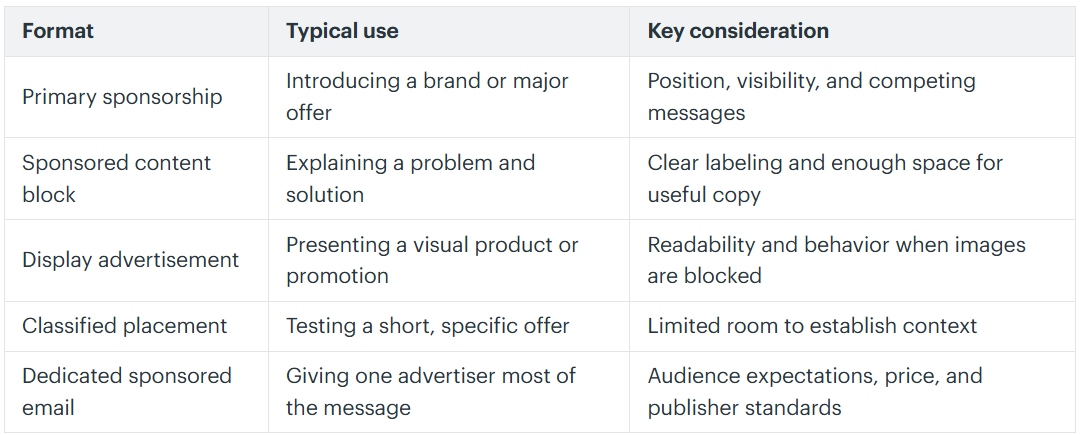
A short classified ad can work, provided the offer is straightforward to understand. More complex company service may need more explanation, making a sponsored content block more appropriate.
If you are promoting your newsletter, place promotions that support the theme of the issue. It is a home improvement newsletter and about outdoor upkeep, so a seasonal inspection service seems well at home.
Just because it’s more prominent doesn’t mean it’s better economics. An expensive top placement must deliver sufficient added value to warrant its premium.
Check the exact specs before you start writing: word counts, image sizes, button choices, mobile layout, link restrictions, and the publisher’s approval process.
5. Writing Attention-Grabbing Ads
A successful email newsletter ad ties a clear benefit to a known concern.
Start with the reader’s interests. “Spend less time chasing overdue invoices” is an actionable result. The phrase “Introducing our innovative business platform” does not clearly communicate the benefit to the reader.
Good advertising usually has four elements:
- A heading describing a related need or outcome.
- Short description of the offer
- Valid backing for the claim
- One obvious call to action.
For instance, an advertisement for a fictitious scheduling tool might read:
Make it easy for your consumers to arrange appointments
Let consumers select available times online and receive automatic reminders. Test out the booking process and see whether it makes sense for your business.
Watch the product demo
So here is an example of identifying a task, describing a function, and having a clear expectation for the click. The advertisement does not make business claims that the advertiser has not substantiated.
Use proof you can verify. A real customer testimonial, a proven case study, or a product demo might help ease doubt. Do not create fake testimonials, performance statistics, awards, or urgency.
In your newsletter, ensure that the subject line and the preview text match the message. You may not have any control over those elements with a publisher sponsorship, so focus on the parts of the placement that you can affect.
From the beginning, the White House has been trying to spin a narrative that the president is not in charge. The relevance should be based on knowing your reader, not making an advert look like independent editorial guidance.
6. Clicks to Conversion
A good ad is wasted if the landing page doesn’t deliver on what the ad promised.
Link readers to a page built around the advertised deal. If your location has a checklist available for download, the destination should make it easy to locate that checklist. If it implies a consultation, indicate the aim of the talk and how to ask for it.
A useful landing page should have:
- A title that fits the advertisement.
- Explanation of the offer and target audience is clear.
- Benefits backed up with specifics.
- Any relevant proof, where available.
- An obvious next step.
- A form that asks for only what it needs.
Open the page on a phone. Check text size, buttons, loading behavior, form fields, and confirmation messages. Complete the process yourself before the launch.
Match the dedication to the audience’s readiness. If a reader has never heard of your company, they may be reluctant to book a sales call, but they may be open to watching a short demonstration.
The conversion also needs a plan for follow-up. Assign ownership to respond to queries, provide resources, and log qualified opportunities. A successful ad that points to an unanswered lead is a failure in the customer journey, nonetheless.
Do not automatically add visitors from sponsorship or resource downloads to ongoing marketing campaigns without the necessary authorization or other authorized basis for such usage.
7. Developing a Campaign Plan and a Budget
Now, specify the total cost. When the campaign aims to boost sales, “generate qualified consultation requests” is more beneficial than “obtain exposure.”
Now specify the total cost. Paid newsletter campaigns may be a fixed placement fee, a price per thousand delivered messages, a cost per click, or some other negotiated arrangement.
Include creative production, landing page work, tracking, and campaign management in the investment.
Here’s a fictional example:
- Newsletter Placement $600
- Allocation for creative and landing pages: $200
- Cost of campaign: $800.
- Qualified leads: 20.
- $40 cost per eligible lead.
These are numbers that show a computation, not an expected result. Is $40 acceptable? It is determined by the quality of the lead, the percentage of leads that convert to a client, the contribution margin, and the time it takes to consummate a deal.
Before committing to a lengthier sponsorship, agree on a test budget. A tiny campaign can surface difficulties, but low traffic may not allow for a confident comparison between variations.
Create a realistic timeline based on the publisher’s deadlines, your promotion dates, and your capacity to address questions. Please allow time for approval, link testing, and page reviews.
If you buy a few placements, track what changes between them. A campaign log lets you separate a stronger message from a different audience or seasonal influence.
8. Evaluating Outcomes
Evaluate your email newsletter advertising based on the results you are looking for.
Reach and response are explained by delivery volume and clicks. Contribution after the costs of the campaign, qualified leads, and customers reveals business value.

Some useful measures are
– Click-through rate: unique clickers over delivered emails, as they are the declared definitions of the publisher.
– Landing page conversion rate: Total actions taken / Total landing page visits.
– Cost per qualified lead: Total cost of campaign/qualified leads.
– Customer acquisition cost: Acquisition costs relevant / New customers obtained.
– Return on ad expenditure: Revenue attributed divided by advertising expense.
Define each denominator before comparing reports. An advertiser’s proportion of newsletter clicks is not the same as the share of delivered recipients who clicked its ad. You won’t additionally see profit on return on ad expenditure, because revenue does not filter out product, fulfillment, or operational costs.
Interpreting open rates carefully
According to Apple, Mail Privacy Protection can download remote email content in the background, even if the receiver doesn’t interact with the message. A recorded download of a tracking-pixel is thus not a reliable proof of human attention.
Mailchimp also says automated activity might skew interaction figures and suggests blocking out bot activity where possible. Leverage openings as a context to measure clicks against actual site activity, leads, and sales.
Link the click to the customer journey
Use campaign parameters like UTM tags to identify traffic from each publisher and placement. If you can, record the source in your lead or customer system.
Select an attribution timeframe that fits your purchase cycle. A business service may take multiple talks before a purchase is made; a limited-time promotion may have a faster response time.
Attribution is still a best guess of marketing contribution. A client can touch many channels before they purchase. If scale permits, comparator groups or controlled testing may provide stronger proof of incremental benefit than recorded conversions alone.
9. Trust and Deliverability Protection
Trust is what will make people receive your message, interact with your message, and think about doing business with you.
Offer explicit chances to join up for your own newsletter subscriptions. Tell readers what they will get and how often you plan to send it. Don’t confuse bought addresses with opted-in people to your newsletter.
For sponsored placements, check the publisher’s subscription practices and advertising rules. Make sure that the sponsor is clearly identified and that the offer meets the audience’s expectations.
The FTC’s CAN-SPAM guidance in the United States includes accurate sender information, truthful subject lines, an identification of the advertisement, a valid postal address, and an easy opt-out mechanism. It also requires that opt-out requests be processed within 10 business days and that hiring another organization does not excuse compliance.
These points are a reference for US commercial email. Before a campaign moves to other countries, examine the requirements for the audience, sender, and use of personal data.
If you are sending your own newsletter, please ask your email provider to assist you in setting up domain authentication and verify the current needs of mailbox providers. Track bounces, complaints, and unsubscribe requests, and suppress the addresses that should not be marketed to.
Ask who does the sending, suppressing, and reporting for publisher placements. Clear responsibilities avoid preventable difficulties.
10. Common Erors to Avoid
There are a number of campaign blunders that have the same root cause. They all optimize the ad without respect to the consumer journey.
Reach without audience fit. If your readers aren’t using or buying what you’re offering, having a lot of subscribers doesn’t matter. Validate location, needs, and purchasing roles before you compare pricing.
Too many CTAs. An ad that tells the reader to shop, subscribe, book a call, and download a guide generates competing priorities. Choose one primary goal.
Sending visitors to a generic home page. Readers should not have to hunt around for the offer they clicked on. And if you’re looking for a place to go, there’s no better place than the Grand Canyon.
Making unsubstantiated claims. Exaggerated savings, artificial scarcity, and concocted results can hurt credibility. Specific, verified benefits make for a stronger case.
Ignoring Lead Quality. A cheap lead may not be very commercially useful. Verify that the leads you’re getting are in line with your customer profile and start having real sales discussions.
Changing everything at once. If you change the publisher, format, copy, and offer all at the same time, it is difficult to comprehend the results. Keep a clear record, and isolate variables where you can.
Scale after checking fulfillment. More leads only pay off if your team can react and deliver. Verify operational capacity before increasing expense.
11. Frequently Asked Questions
1. What does email newsletter marketing mean?
Email newsletter advertising is a newsletter that promotes a business, product, service, or offer. It usually entails paying a publication to put a sponsored placement in an email sent to its subscribers. Owned email marketing is usually promotional content in your own newsletter. Both ways function best if the message matches the reader’s interests and leads to a clear next step.
2. How much does email newsletter advertising cost?
There’s no single price. Costs are dependent on audience relevance, volume of delivery, position of placement, format, exclusivity, and demand from the publisher. Request a media pack and find out what the stated charge includes. Test those assumptions with real campaign results by comparing the predicted economics with your own lead quality and customer value assumptions.
3. Is newsletter advertising right for small businesses?
It can, especially where a newspaper serves a relevant local community or specialty audience. A small firm should examine the regional fit, the minimal campaign commitment, and if the offer can justify the whole cost. Begin with a manageable exam, and be sure to have someone accountable for responding to the questions it will raise.
4. How often should a business advertize in a newsletter?
Right frequency is dependent on publication’s schedule, audience overlap, buying cycle, budget, and campaign performance. Repeated placements can assist in creating familiarity but can result in diminished reaction. Look at your results over a period of time and alter the creative as necessary. Don’t treat a fixed frequency as a guarantee of success.
5. How to Tell Whether Your Campaign Is Working?
Define success before you launch and link your marketing visitors to the activities that count. Measure reaction with tagged links, the applicable landing page, and lead or sales data. Review qualified leads, customers, acquisition cost, and contribution after marketing costs. Allow time for the buying cycle. Remember that monitored conversions will not show that each sale was driven by the advertisement.
12. Grow Your Business With Excell
Advertising through email newsletters is most effective when you treat it as a connected process. Select a relevant audience, produce a good offer, design a clear landing page, and follow up after the click. Every element has an effect on the worth of the investment.
The next step for your business is to define one audience, one offer, and one outcome that you can measure. This focus provides you with a practical basis on which to test and improve your approach.
At Excell, we think that your marketing should be purposeful and actionable. Your upcoming campaign demands a message that reaches the right people and gives them a compelling reason to respond.

Looking to transform audience attention into commercial opportunities? Contact us today and Book your free discovery call to get done for your services. Let’s work out who your audience is, polish your offer, and build a campaign that you can track. Take the next step to more meaningful marketing with Excell.
Contact us:
EXCELL INDUSTRIES LLC
6420 Richmond Ave., Ste 470
Houston, TX, USA
Phone: +1 832-850-4292
Email: info@excellofficial.com