

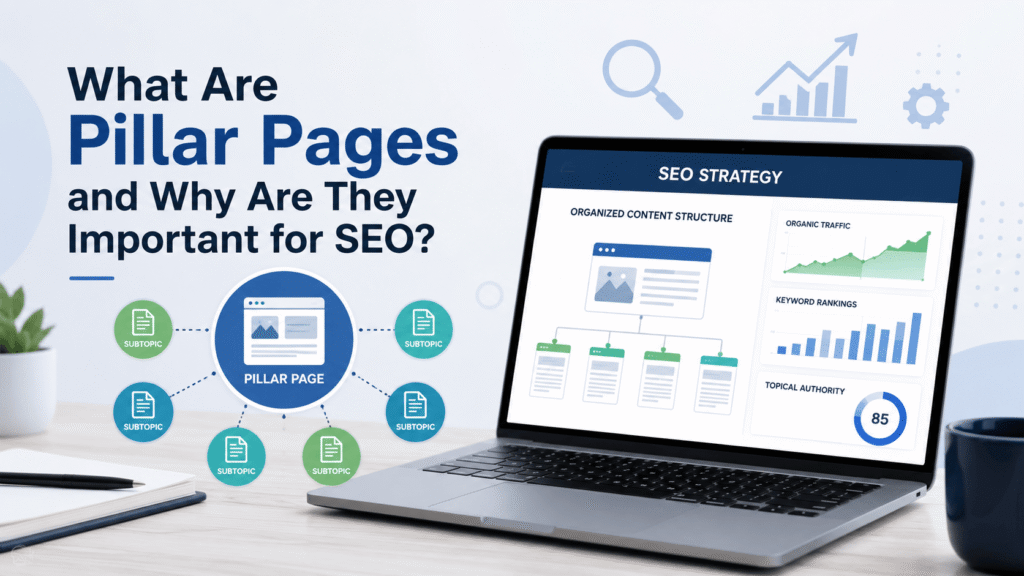
If you’ve been researching modern SEO strategies, you’ve probably come across the question: what are pillar pages? They have become one of the most effective methods for organizing website content, improving search engine rankings, and creating a better user experience.
Rather than publishing dozens of disconnected blog posts, pillar pages help organize your content into meaningful topics that search engines and readers can easily understand. Google’s algorithms increasingly reward websites that demonstrate topical authority, and pillar pages are one of the best ways to achieve that goal.
Whether you’re running a small business, an eCommerce store, or a corporate website, understanding what pillar pages are can dramatically improve your content marketing strategy.
Table of Contents:
- What Are Pillar Pages?
- Why Pillar Pages Matter for SEO
- How Pillar Pages Work?
- Pillar Pages vs Regular Blog Posts
- Types of Pillar Pages
- Benefits of Using Pillar Pages
- How to Create an Effective Pillar Page?
- Choosing the Right Topic Cluster
- Internal Linking Best Practices
- Common Mistakes to Avoid
- Examples of Successful Pillar Pages
- Measuring the Success of Your Pillar Pages
- Frequently Asked Questions
- Final Thoughts
What Are Pillar Pages?
A pillar page is a comprehensive, authoritative webpage designed to cover a broad topic in a single, organized resource while strategically linking to multiple related articles that explore individual subtopics in greater depth. Rather than attempting to answer every question in exhaustive detail on one page, a pillar page serves as the central hub of a content cluster, providing readers with a complete overview of the subject and guiding them to more specialized resources for additional information.
Think of a pillar page as the foundation of your content marketing strategy. If your website were a library, the pillar page would represent an entire section dedicated to a specific subject. At the same time, the supporting articles would be the individual books that dive into each aspect of that topic. This organized structure helps both users and search engines understand how your content is connected, making your website easier to navigate and more authoritative in the eyes of Google.
Unlike a traditional blog post that focuses on answering a single question or targeting one long-tail keyword, a pillar page is intentionally broad. It addresses the primary topic from multiple angles, offering readers a complete understanding of the subject while naturally introducing related concepts that deserve their own in-depth articles. This approach creates a seamless learning experience and encourages visitors to explore more of your content.
For example, imagine your website focuses on Digital Marketing. Instead of publishing unrelated articles about different marketing tactics, you could create a comprehensive pillar page titled “The Ultimate Guide to Digital Marketing.” This page would introduce the major components of digital marketing and provide readers with a structured overview of each area, including:

- Search Engine Optimization (SEO) – Strategies for improving organic search visibility and increasing website traffic.
- Pay-Per-Click (PPC) Advertising – How paid search campaigns drive targeted traffic and measurable results.
- Social Media Marketing – Using platforms like Facebook, Instagram, LinkedIn, and TikTok to build brand awareness and engage customers.
- Email Marketing – Best practices for nurturing leads, retaining customers, and increasing conversions through personalized email campaigns.
- Content Marketing – Creating valuable, informative, and engaging content that attracts and educates your target audience.
- Marketing Analytics – Measuring campaign performance through key metrics, data analysis, and reporting tools.
Rather than covering every one of these topics in exhaustive detail on the pillar page itself, each section provides a concise overview and strategically links to a dedicated article that explores the subject more comprehensively. For instance, the SEO section would link to supporting content about keyword research, on-page SEO, technical SEO, local SEO, link building, and content optimization. Similarly, the content marketing section could connect readers to articles about blogging, content calendars, storytelling, and AI-assisted content creation.
This interconnected framework is known as a topic cluster, one of the most effective content organization strategies in modern SEO.
A topic cluster consists of three essential components:
- The Pillar Page – A comprehensive resource that introduces the primary topic and serves as the central authority.
- Cluster Content – Multiple supporting articles that cover individual subtopics in greater detail.
- Strategic Internal Links – A network of links connecting the pillar page with every supporting article and vice versa, helping users and search engines understand the relationship between the content.
This structure creates a logical hierarchy that benefits both readers and search engines. Visitors can quickly navigate from broad concepts to detailed information without leaving your website, while search engine crawlers gain a clearer understanding of your site’s architecture and topical expertise.
From an SEO perspective, pillar pages signal to Google that your website doesn’t simply publish isolated articles; it provides comprehensive coverage of an entire subject. Every supporting article reinforces the authority of the pillar page, and every internal link strengthens the relationship between your content. Over time, this interconnected ecosystem helps establish topical authority, one of the strongest indicators that your website deserves to rank for competitive search queries.
Beyond improving search visibility, pillar pages also create a significantly better user experience. Instead of forcing readers to search through multiple unrelated blog posts, they can access an organized resource that answers their initial questions while guiding them toward more specialized information. This often leads to longer session durations, lower bounce rates, increased page views, and higher engagement behavioral signals that can further support your SEO performance.
Ultimately, a pillar page transforms your website from a collection of standalone blog posts into a structured knowledge hub. It organizes your content around the topics that matter most to your audience, demonstrates your expertise, and builds trust with both readers and search engines. When executed correctly, pillar pages become long-term digital assets that continually attract organic traffic, support your broader content marketing strategy, and position your business as a recognized authority within your industry.
Why Pillar Pages Matter for SEO?
Search engine optimization has evolved far beyond simply placing keywords throughout a webpage. Modern search engines, particularly Google, prioritize websites that demonstrate topical authority, exceptional user experience, and well-structured content. Instead of evaluating individual pages in isolation, Google’s algorithms assess how effectively your website covers a subject and how your content connects across related topics.
This is where pillar pages become a game-changer.
A well-developed pillar page acts as the cornerstone of your content strategy, providing a comprehensive overview of a broad topic while seamlessly linking to supporting articles that explore specific subtopics in greater depth. This interconnected structure helps search engines understand the relationship between your content and establishes your website as a trusted resource within your niche.
Google’s ranking systems now consider several key signals when determining search visibility, including:
- Topical authority – Demonstrates your expertise by comprehensively covering an entire subject rather than a single keyword.
- Content relevance – Ensures your content closely aligns with user search intent and answers their questions thoroughly.
- User experience – Makes it easier for visitors to navigate your website, find valuable information, and stay engaged longer.
- Internal linking – Creates a logical content hierarchy that helps search engines crawl and index your pages more efficiently.
- Website architecture – Organizes your content into a clear, scalable structure that enhances both usability and SEO performance.
Pillar pages strengthen each of these ranking factors by creating a cohesive network of related content. As search engine crawlers move through your website, they recognize the pillar page as the primary resource for the topic. In contrast, the supporting cluster pages reinforce its authority through strategic internal linking.
The result is a stronger topical footprint, improved crawlability, and greater semantic relevance, all of which increase your chances of ranking for competitive keywords and attracting high-quality organic traffic. Beyond higher rankings, pillar pages also provide a better experience for your audience, encouraging visitors to explore additional resources, spend more time on your website, and ultimately convert into loyal customers.
This version is more persuasive, authoritative, and aligned with Google’s emphasis on topical authority and user experience while naturally supporting SEO.
How Pillar Pages Work?
Imagine your website as a library.
Without organization:
- Books are scattered
- Topics overlap
- Visitors get confused
Now imagine books organized into categories. Finding information becomes easier. Pillar pages work the same way.
Example:
Pillar Page
SEO Guide
Supporting Articles
- Keyword Research
- On-Page SEO
- Technical SEO
- Link Building
- Local SEO
- SEO Audits
- SEO Tools
- Schema Markup
Every supporting article links back to the pillar page.
The pillar page links to every supporting article.
This creates a powerful internal linking network.
Pillar Pages vs Regular Blog Posts
Understanding the difference is important.
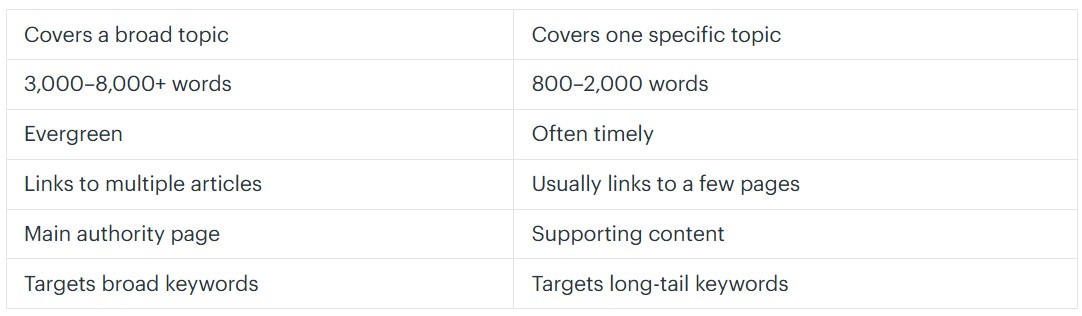
For example:
Pillar Page:
What Are Pillar Pages?
Supporting Articles:
- How to Create Topic Clusters
- Internal Linking Guide
- Keyword Mapping
- SEO Content Strategy
- Pillar Page Templates
Types of Pillar Pages
There isn’t just one type.
1. Ultimate Guide Pillar
The most common format.
Example:
Complete Guide to SEO
2. Resource Pillar
A curated collection of valuable resources.
Example:
Best SEO Tools
3. Product or Service Pillar
Explains services while linking to related pages.
Example:
Digital Marketing Services
4. Educational Pillar
Focuses on teaching readers.
Example:
SEO for Beginners
5. Topic Cluster Pillar
Acts as the central hub for dozens of articles.
Example:
Home Insurance Claims
Benefits of Using Pillar Pages
Better Search Rankings
Search engines appreciate organized websites.
Pillar pages make it easier to understand your expertise.
Increased Organic Traffic
One pillar page can rank for hundreds of keywords.
Instead of targeting one phrase, you’re building authority around an entire topic.
Improved User Experience
Visitors can quickly find related information.
They spend more time on your website.
Lower bounce rates often lead to better SEO performance.
Stronger Internal Linking
Internal links pass authority between pages.
A strong internal linking structure helps Google crawl your website more efficiently.
Higher Engagement
Readers naturally click into supporting articles.
This increases:
- Pages per session
- Average session duration
- Visitor retention
Better Content Organization
Rather than producing random blog posts, every new article has a clear purpose.
Each one supports the pillar page.
Easier Content Planning
Instead of wondering what to write next, create another supporting article.
Eventually, your topic cluster becomes increasingly authoritative.
How to Create an Effective Pillar Page?
Step 1: Choose One Broad Topic
Examples include:
- Personal Injury
- Roofing
- Home Insurance
- Digital Marketing
- SEO
- Content Marketing
Avoid topics that are too broad.
For example:
Marketing
Instead choose:
Content Marketing
Step 2: Perform Keyword Research
Identify:
Primary keyword
what are pillar pages?
Related keywords
- pillar page examples
- pillar page strategy
- topic clusters
- SEO content strategy
- internal linking
- content hubs
Use keyword research tools to uncover search volume, competition, and user intent.
Step 3: Create Supporting Articles
Every subtopic deserves its own article.
Example:
Main Page:
What Are Pillar Pages
Supporting Articles:
- Topic Clusters Explained
- SEO Content Strategy
- Content Mapping
- Internal Linking Guide
- How Google Understands Topics
Step 4: Build Internal Links
Every supporting article should link back to the pillar page using descriptive anchor text.
Likewise, the pillar page should naturally link to each supporting article where relevant.
This creates a logical content hierarchy that search engines can easily follow.
Step 5: Keep It Evergreen
Update your pillar page regularly by:
- Adding new statistics
- Refreshing examples
- Including new best practices
- Updating screenshots
- Linking to newly published articles
Fresh, comprehensive content tends to perform better over time.
Choosing the Right Topic Cluster
Selecting the right pillar topic is crucial.
Ask yourself:
- Does the topic have enough depth?
- Can I create at least 10 supporting articles?
- Is there meaningful search demand?
- Does it align with my business offerings?
- Will it remain relevant for years?
If the answer is yes, you’ve likely found a strong pillar topic.
Internal Linking Best Practices
Internal linking is one of the biggest strengths of pillar pages.
Follow these best practices:
- Use descriptive anchor text instead of generic phrases like “click here.”
- Link naturally within the content.
- Ensure every cluster article links back to the pillar page.
- Add links to related cluster articles where appropriate.
- Regularly audit links to avoid broken or outdated references.
A well-planned internal linking strategy distributes authority throughout your website and helps users discover more relevant content.
Common Mistakes to Avoid
Many businesses create pillar pages but miss the mark. Avoid these common pitfalls:
Choosing Topics That Are Too Broad
Trying to cover an enormous subject like “Marketing” makes it difficult to provide meaningful depth. Narrow your focus.
Writing Thin Content
A pillar page should answer the primary questions users have about a topic. Thin pages rarely earn authority or backlinks.
Ignoring Search Intent
Understand whether users are looking for educational information, comparisons, or services. Your content should match that intent.
Neglecting Internal Links
Without strong internal links, a pillar page loses much of its SEO value.
Forgetting to Update Content
SEO evolves, and so should your pillar pages. Schedule periodic reviews to keep information accurate and competitive.
Examples of Successful Pillar Pages
Here are a few examples of industries that benefit from pillar page strategies:
Digital Marketing Agency
Pillar Page: SEO Services
Supporting Content:
- Keyword Research Guide
- Technical SEO Checklist
- Local SEO Tips
- Link Building Strategies
- On-Page SEO Best Practices
Law Firm
Pillar Page: Personal Injury Claims
Supporting Content:
- Car Accident Claims
- Slip and Fall Cases
- Medical Malpractice
- Wrongful Death
- Settlement Timelines
Home Services Company
Pillar Page: Roof Replacement
Supporting Content:
- Roof Inspection
- Asphalt Shingles
- Metal Roofing
- Roof Maintenance
- Insurance Claims for Roof Damage
In each example, the pillar page serves as the central resource while supporting articles build topical authority.
Measuring the Success of Your Pillar Pages
Creating a pillar page is only the beginning. To understand whether it’s delivering results, monitor key performance indicators over time.
Organic Traffic
Use analytics tools to track the number of visitors arriving through search engines. A successful pillar page should gradually attract more organic traffic as it gains authority.
Keyword Rankings
Monitor rankings for your primary keyword (“what are pillar pages”) as well as related long-tail keywords. Improvements across multiple terms indicate growing topical relevance.
User Engagement
Review metrics such as:
- Average time on page
- Pages per session
- Bounce rate
- Scroll depth
High engagement suggests visitors find the content valuable.
Backlinks
Comprehensive pillar pages often earn backlinks naturally because they serve as useful references—track referring domains to measure authority growth.
Conversions
If your goal is lead generation, monitor:
- Contact form submissions
- Consultation requests
- Newsletter sign-ups
- Product inquiries
Strong pillar pages should contribute to meaningful business outcomes, not just traffic.
Frequently Asked Questions
1. What are pillar pages in SEO?
Pillar pages are comprehensive content hubs that cover a broad topic and connect to multiple related articles through internal links. They help organize content, improve user experience, and strengthen topical authority for search engines.
2. How long should a pillar page be?
While there is no strict rule, most effective pillar pages range from 3,000 to 5,000 words or more. The goal is to provide complete, high-quality coverage of the topic rather than meeting a specific word count.
3. How many supporting articles should a pillar page have?
A strong topic cluster typically includes 8 to 20 supporting articles, though some industries benefit from even larger clusters. The number depends on the depth of the subject and your audience’s needs.
4. Can small businesses benefit from pillar pages?
Absolutely. Pillar pages help businesses of all sizes compete by demonstrating expertise in a specific niche. Even local businesses can use pillar pages to organize content around their services and attract targeted organic traffic.
5. How often should pillar pages be updated?
Review your pillar pages at least every six to twelve months. Update statistics, refresh examples, improve internal links, and add links to newly published supporting content to maintain relevance and performance.
Final Thoughts
Understanding what pillar pages are is essential for anyone serious about improving SEO performance and building long-term organic visibility. Rather than treating every blog post as a standalone asset, pillar pages organize your content into logical topic clusters that demonstrate expertise, improve internal linking, and provide a better experience for both users and search engines.
A well-crafted pillar page becomes a foundational asset for your website. It attracts qualified traffic, supports higher rankings for competitive keywords, encourages visitors to explore related content, and positions your brand as a trusted authority within your industry. Combined with regular updates and a thoughtful content strategy, pillar pages can deliver lasting SEO value for years to come.
Ready to Build an SEO Strategy That Delivers Results?
Creating high-performing pillar pages takes more than writing long-form content; it requires strategic planning, keyword research, content architecture, and technical SEO expertise. That’s where Excell comes in.
At Excell, we help businesses develop SEO-driven content strategies that increase organic traffic, improve search rankings, and generate qualified leads. From building comprehensive pillar pages and topic clusters to optimizing your website’s technical performance, our team is committed to helping your business achieve sustainable online growth.

Don’t let your competitors dominate the search results. Partner with Excell today and discover how expertly crafted pillar pages can strengthen your website’s authority, attract more customers, and drive measurable business success. Contact us today and Book your free discovery call to get done for your services.
EXCELL INDUSTRIES LLC
6420 Richmond Ave., Ste 470
Houston, TX, USA
Phone: +1 832-850-4292
Email: info@excellofficial.com